THC Crystals: What They Are, How They’re Made and How to Use Them

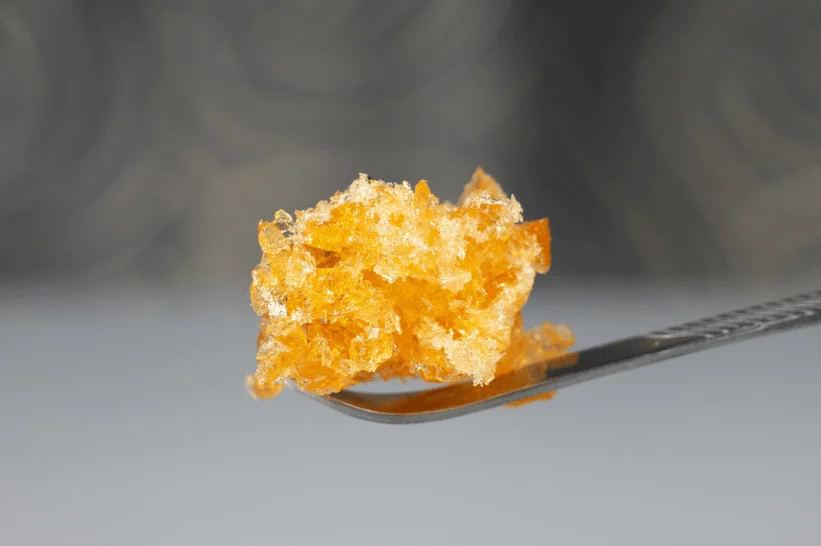
Quick Answer: THC crystals are ultra-refined hemp-derived concentrates that often test above 99% THCA, making them one of the strongest cannabinoid formats on the market. They look like clear, glass-like chunks or fine white powder, and they only become intoxicating when heated, which converts THCA into delta-9 THC.
People who shop for THC crystals usually want three answers: what they actually are, how strong they really get, and how to use them without accidentally taking way too much. This guide covers all three, plus the serving-size math many guides skip, the latest federal hemp rules you need to know before buying, and how crystals compare to other cannabis products like distillate, live resin, and hemp flower.
🔑 Key Takeaways:
- THC crystals are 90% to 99%+ THCA isolate, one of the purest forms of hemp-derived cannabinoids you can buy.
- Raw crystals are not intoxicating. They need heat, such as dabbing, vaping, smoking or decarbing, to convert into active delta-9 THC.
- A 99% crystal delivers at most about 868 mg of THC per gram, so a 5 mg beginner serving is less than a pinch and nearly impossible to weigh on a standard home scale.
- Federal hemp rules are shifting on December 11, 2026, and finished hemp products will be capped at 0.4 mg total THC per container.
What Are THC Crystals?
THC crystals, sometimes called crystalline or crystallized THC, are a cannabinoid isolate. That means a single cannabinoid has been separated from the rest of the plant material, including terpenes, flavonoids, fats, waxes and other cannabinoids, and refined down to a near-pure solid.
Almost every product labeled “THC crystals” is actually THCA crystals. THCA is the raw, non-intoxicating acid form of THC found in living cannabis plants, and it only becomes the delta-9 THC people associate with a “high” after heat decarboxylates it. So the name describes what the crystals turn into, not what is in the jar.
The three most common formats you’ll see are powder, diamonds, and ultra-high-purity isolate.
THC Crystal Powder
THC crystal powder is crystalline that has been crushed or formed into a fine, white-to-clear powder. The texture ranges from flour-fine to coarse sugar, depending on how it was processed. This format is easy to sprinkle over flower, pack into a bowl, or measure into a carrier oil for infusions.
THC Diamond Crystals
THC diamond crystals are the showpieces of the concentrate world. They are larger, rock-like THCA crystals grown slowly out of a terpene-rich extract, often sold alongside their mother liquor as “diamonds and sauce.”
Diamond crystals usually test around 90% to 99% THCA. The leftover sauce around them carries the strain’s terpene profile for flavor and aroma, while the crystals themselves carry the raw strength. For more on this format, see our breakdown on THCA diamonds.
Pure THC Crystals
“Pure” THC crystals typically means 98% to 99%+ THCA isolate with almost no terpenes or other cannabinoids left behind. Keep in mind that pure doesn’t mean 100% THC once heated, since the molecule loses weight during decarboxylation. Purity is only real if a current, third-party lab report confirms it.
-
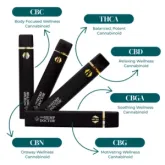
ZOOTED | THCA LIVE RESIN DISPOSABLE VAPE | 1G
$34.95Shop Now This product has multiple variants. The options may be chosen on the product page -

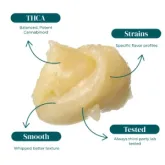
THCA BATTER | 2G
$49.95Shop Now This product has multiple variants. The options may be chosen on the product page
How Are THC Crystals Made?
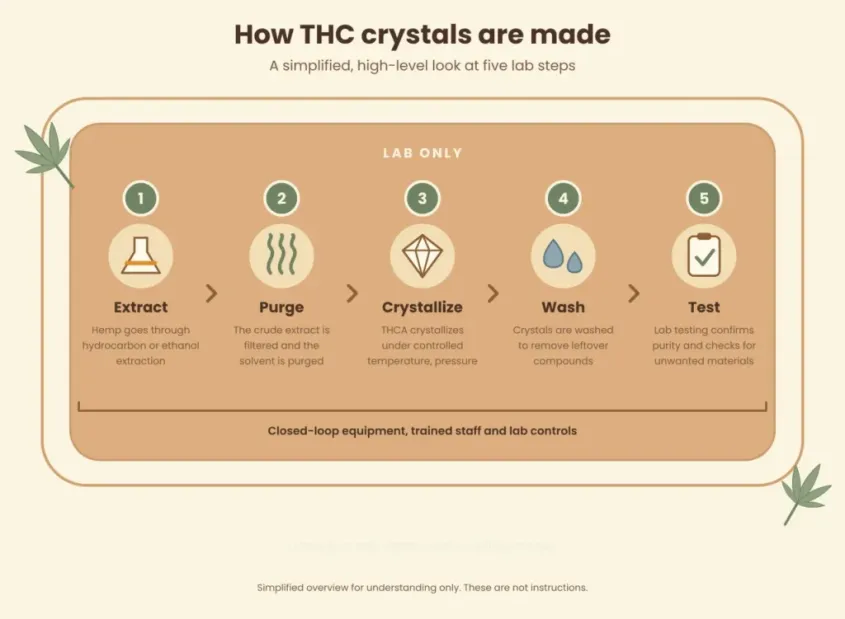
Making THC crystals is a lab-only process, not a DIY project. At a high level, it looks like this: raw hemp is run through a hydrocarbon or ethanol extraction, the crude extract is filtered and the solvent is purged, then THCA is crystallized under tightly controlled temperature and pressure, washed to remove leftover compounds, and finally tested for purity and unwanted materials.
Diamond crystals form through slow nucleation inside a sealed vessel, often over days or weeks. The crystals grow out of the sauce as the solvent slowly evaporates under controlled conditions.
A quick safety reminder: this process requires closed-loop extraction equipment and lab controls. Home solvent extraction has caused house fires and explosions. The same basic workflow, refined further, is how “THC isolate crystals” are produced, so there is no realistic kitchen version of this.
How to Make THC Vape Liquid With Crystals
To make THC vape liquid with crystals, gently warm the crystals together with a vape-safe carrier, such as food-grade terpenes or a commercial cannabis-specific thinner, stir until the mixture is fully clear, let it cool, then fill your cart.
Here’s a simple dilution example. 100 mg of crystals in 10 mL of carrier gives you 10 mg of crystal per mL, or about 8.7 mg of THC per mL after conversion. That lets you measure servings in drops instead of trying to weigh tiny amounts of powder.
One important safety note: never use PG, VG, PEG or vitamin E acetate as a carrier. Vitamin E acetate was linked to the 2019 EVALI outbreak. Also, crystals can re-crystallize inside the cart over time. If this feels like too much, pre-filled, lab-tested THC vape cartridges skip the guesswork entirely.
How Strong Are THC Crystals?
Crystals typically test 90% to 99%+ THCA. For comparison, flower usually lands at 15% to 30% THC, and most other concentrates fall somewhere between 60% and 90%.
Here’s the part most guides skip. THCA loses weight when it’s heated because it sheds a carboxyl group during decarboxylation. The real-world THC yield works out to about 87.7% of the starting THCA weight. So a 99% pure crystal delivers at most about 868 mg of THC per gram, assuming full conversion.
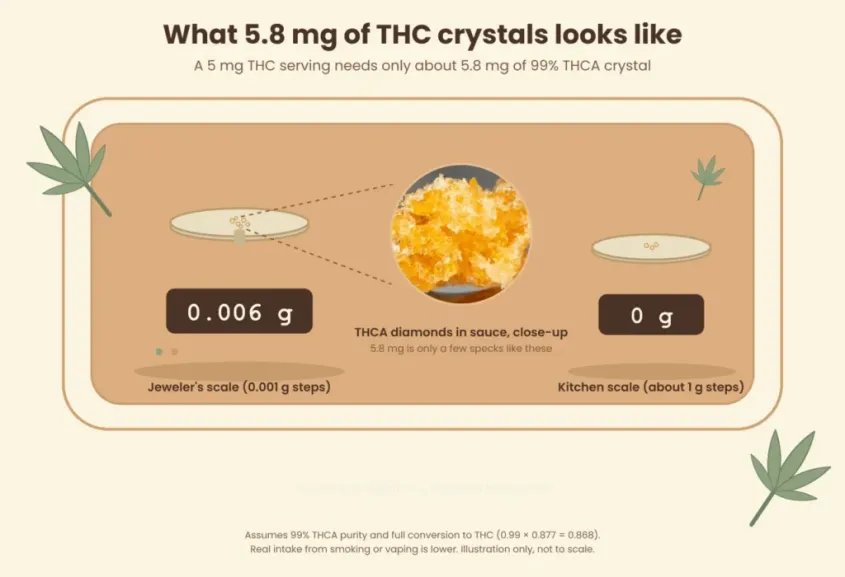
That matters because a beginner serving of 2.5 to 5 mg THC only needs about 3 to 6 mg of crystal. That is less than a pinch and well below what a standard kitchen scale can accurately measure. This is the quiet reason so many first-timers accidentally take too much.
THCA-to-THC Serving Conversion Table
The numbers below assume 99% purity and full conversion: 0.99 × 0.877 = 0.868. Real intake from smoking or vaping will be lower, since some THC is lost to combustion and sidestream smoke.
| Target THC amount | Crystal needed, approx. | Suggested experience level |
| 2.5 mg | ~2.9 mg | First-time consumers |
| 5 mg | ~5.8 mg | Low tolerance / beginners |
| 10 mg | ~11.5 mg | Moderate tolerance |
| 20 mg | ~23 mg | Experienced consumers only |
A milligram, or 0.001 g, jeweler’s scale or a liquid dilution is the only reliable way to measure a small amount at home. If your product’s purity is different, the formula is: crystal needed = target THC ÷ purity × 0.877. If measuring tiny amounts sounds like a hassle, pre-measured options like Delta 9 gummies do the math for you.
Do THC Crystals Get You High? THC Crystals Experience
Yes, once heated. Raw THCA is not intoxicating, but dabbing, vaping, smoking or decarbing converts it into delta-9 THC.
Many consumers describe heated THC crystals as producing a strong, fast-acting, noticeably intoxicating experience. Some users report euphoria, a relaxed feel, a heavier body sensation, and changes in sensory perception. Timing can vary by person and by method of use. When inhaled, the experience often begins quickly and may last a few hours. When decarbed and eaten, the experience usually takes longer to begin and may last longer than inhaled formats.
Some consumers report unwanted experiences after taking larger amounts, such as feeling uneasy, having a racing heartbeat, dry mouth, dizziness or paranoia. Because isolates strip out most terpenes, the experience can feel “flatter” or more one-dimensional than a full-spectrum product like live resin.
Different Ways THC Crystals Are Used
There are four common methods, and each one fits a different type of adult consumer.
Sprinkling on flower means adding a tiny amount of crystal to a bowl, joint or THCA flower to boost strength. This works best for flower smokers who want a stronger session without buying a dab rig.
Dabbing vaporizes the crystal on a rig or e-rig at low temperature. It is an efficient method, but it’s really an experienced-consumer approach.
Infusing a vape means dissolving crystals into a vape-safe carrier for a refillable pen, covered below. This suits adult consumers who want a discreet, portable format.
Cooking works too, but crystals must be decarbed first at around 240°F, or 115°C, and then infused into a fat like butter or coconut oil since cannabinoids mix well with fats. This is best for people who want an edible-style experience and can measure accurately.
If none of that sounds practical, pre-measured formats like THCA gummies or Delta 9 edibles skip the measuring problem entirely.
Best Way to Smoke THC Crystals
Low-temperature dabbing at roughly 315°F to 450°F is the best way to smoke THC crystals if you care about efficiency and flavor. It wastes less product, tastes cleaner, and is easier to control than cranking the heat up.
The easiest method for most people is layering crystals in a bowl, with flower on the bottom, a small amount of crystal in the middle, and more flower on top. That way the flame never touches the crystals directly.
Sprinkling into a joint works too, though it can burn unevenly and waste more product. Avoid direct high heat, since it burns off THC and makes the hit harsh. For ready-rolled options, see THCA pre-rolls.
How to Use a THC Diamond Crystal Disposable Vape
If you’ve picked up a diamond disposable, here is how to use a THC diamond crystal disposable vape properly.
- Remove any packaging and plug, since some have silicone plugs on the mouthpiece and airflow hole.
- Charge it if it’s rechargeable.
- Either inhale to activate, if draw-activated, or press the button a few times according to the instructions.
- Take a slow 2 to 3 second pull, then wait 10 to 15 minutes before the next hit to gauge the experience.
Before you buy any diamond disposable, check for a COA, the listed cannabinoid percentage, the hardware brand and tank capacity, USB-C rechargeability, and confirmation that there are no cutting agents like PG, VG or vitamin E. Browse our THCA vapes collection for lab-tested options.
How THC Crystals Stack Up Against Other Concentrates
Overall, THC crystals win on strength but lose on flavor. Here’s how they compare to other popular cannabis products:
| Format | Typical strength range | Flavor | Best use | Beginner-friendly |
| THC crystals | 90% to 99%+ | Neutral | Dabbing, boosting flower | Low |
| Distillate | 80% to 95% | Mild, terps added | Vapes, edibles | Medium |
| Live resin | 60% to 85% | Strong, fresh | Dabbing, carts | Medium |
| Rosin | 60% to 80% | Strong, full-spectrum | Dabbing | Medium |
| Kief | 20% to 60% | Mild to moderate | Topping bowls or joints | Medium to high |
| Flower | 15% to 30% | Full terpene profile | Smoking, pre-rolls | High |
Ranges are typical, not guaranteed, and vary by batch.
The first thing to understand about this table is that the percentages don’t all measure the same thing. Crystals and most flower are labeled by THCA, not THC, and THCA only becomes THC once it is heated. Flower listing 25% THCA delivers about 22% THC, while crystals at 99% THCA top out around 87%. So crystals are strong, but not “99% THC” strong, and the gap to flower is smaller than the label suggests.
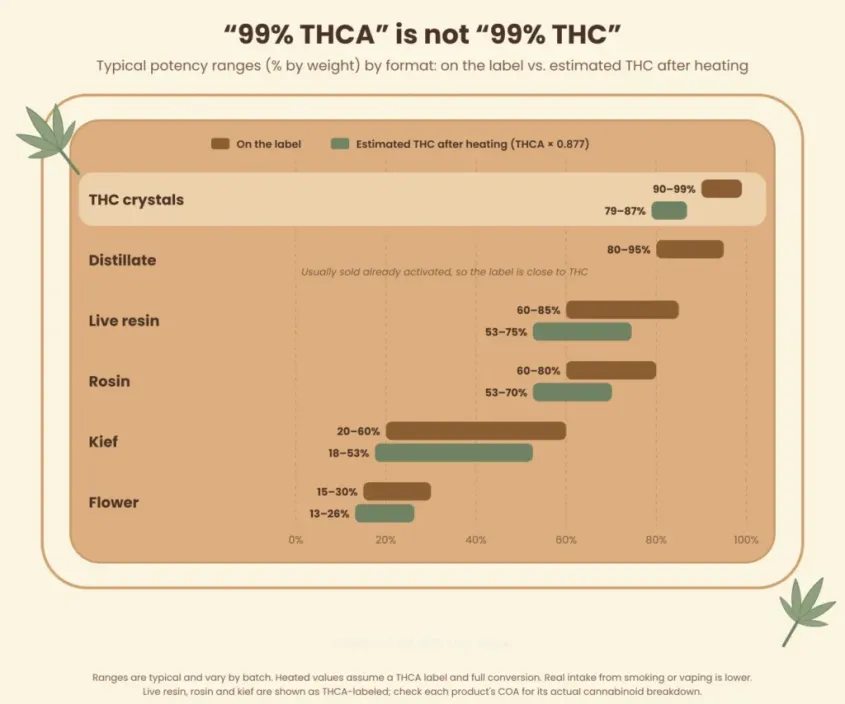
Even with the numbers sorted out, strength only tells part of the story. Crystals are flavorless and carry no terpenes, so they deliver THC without the taste or harshness that usually comes with a strong dose. Formats that keep their terpenes, like live resin and rosin, tend to feel fuller because the whole profile reaches the user. That is what many people mean by the full effect of cannabis products.
This is also why each format has built its own reputation. Kief is the mild step up, since it is simply sifted from flower. Distillate is the workhorse for vapes and edibles because it is potent and easy to flavor, while live resin and rosin are favored when flavor matters most. Flower remains the most familiar and lowest-potency option, and crystals sit at the far end as the purest, strongest and plainest of the group.
If you want a closer look at two of the most common extracts, see live resin vs distillate.
Safety: Drug Testing and Storage
THCA converts to THC once heated, so using crystals can lead to a positive drug test. Standard screens look for THC metabolites rather than the product you used, which means a hemp-derived or legally purchased label doesn’t change the result. Because crystals are so concentrated, a small amount delivers a lot of THC, and how long it stays detectable depends on the person, how often they use, and the type of test. Occasional users generally clear sooner than daily users. For a fuller look, see how long THCA stays in your system.
THC can affect the liver enzymes that process many prescription drugs, which may strengthen or prolong their effects. Anyone on regular medication, or with a health condition, should talk with a healthcare professional before using crystals or any other cannabis product.
As for storage, heat, light and air slowly degrade cannabinoids, and heat can also start converting THCA to THC before you intend it to. That is why crystals are best kept in an airtight glass jar somewhere cool, dry and dark. Some retailers note that sealed crystals tolerate freezing for long-term storage, as long as moisture stays out.
Crystals also look a lot like sugar or candy, so they should be kept well out of reach of children and pets, both of whom can be seriously affected by THC.
Are THC Crystals Legal? 2026 Update
Not as hemp, for much longer. Under the 2025 federal law, THCA crystals no longer qualify as legal hemp once the new total THC standard starts on December 11, 2026, which leaves them to be treated like cannabis under federal and state rules.
It wasn’t always this way. The 2018 Farm Bill only counted delta-9 THC when deciding what qualified as hemp, and raw THCA doesn’t show up as delta-9. That gap is what let THCA products like crystals, diamonds and flower be sold as legal hemp.
The 2025 law closed that gap. Hemp is now defined by total THC, and THCA counts toward that total. Finished hemp products are also capped at 0.4 mg of total THC per container. To put that in perspective, a single gram of THCA crystals holds hundreds of milligrams, so crystals and diamonds fall squarely under this change.
The dates have moved around, so here is where things stand as of November 20, 2026:
- November 12, 2026: the ban on synthetic cannabinoids in hemp products took effect, as originally planned.
- December 11, 2026: a later spending bill pushed the total THC standard and the 0.4 mg container cap from November 12 to this date, giving Congress extra time to consider a regulatory framework.
Because lawmakers are still debating what comes next, those dates could shift again.
States add another layer. Some have already moved ahead of the federal timeline. Ohio, for example, has applied the container cap since March 20, 2026. Others still allow THCA products under their own rules, and a few restrict them heavily, so a product that’s lawful in one state may not be in the next. Checking your own state’s current rules matters more than any national summary, including this one.
This is general information, not legal advice. State laws vary and continue to shift, so confirm your state’s current rules before buying or traveling with any THCA product.
Final Thoughts
THC crystals are one of the strongest hemp-derived formats you can buy, but strength without precision can lead to an uncomfortable experience. Remember that crystals are mostly THCA, that they need heat to convert, and that a beginner serving is too small to weigh accurately at home. Start with a small amount, read the COA, and go slowly.
If you’re comparing options, explore The Hemp Doctor’s lab-tested THCA concentrates and always review the COA before choosing what fits your tolerance.
FAQs
What do THC crystals do?
Once heated, THC crystals provide a highly concentrated amount of delta-9 THC with a fast-acting, intoxicating experience. In their raw form, they are mostly non-intoxicating THCA.
Can you buy pure THC crystals?
Yes. THCA isolate and diamonds testing 98% to 99%+ are sold by hemp retailers where state law allows. Federal rules shift on December 11, 2026, so check current availability and always ask for a batch-matched COA.
How do you make THC isolate crystals?
They’re produced in a lab by extracting cannabinoids from hemp, purifying the extract, and crystallizing the THCA under controlled temperature and pressure. It is not a safe DIY project because of the solvents and specialized equipment involved.
Are diamond crystals stronger than regular flower?
Yes. Flower usually tests 15% to 30% THC, while diamonds sit around 90% to 99% THCA, which converts to roughly 868 mg of THC per gram at full purity.