THCA Isolate: What It Is, How It’s Made & How To Use It

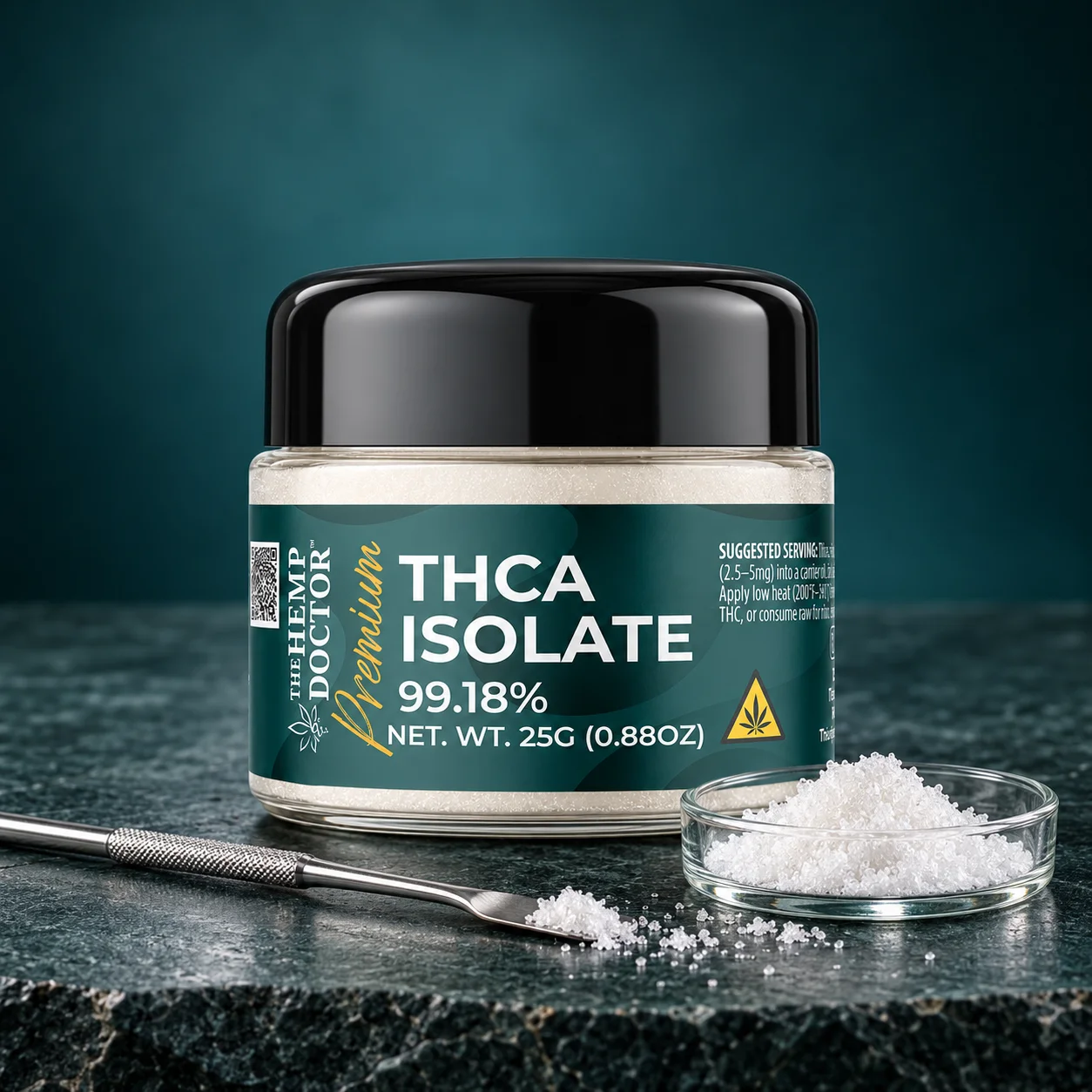
THCA isolate stands out from almost every other hemp product on the market for one reason: it is a single compound in powder form, with no terpenes, no flavor, and no aroma. That makes it a blank slate for adults who want precise control over serving size without the taste of flower or the carrier oils in a vape.
This guide covers what it is, how it is produced, common ways adults use it, how it stacks up against THCA diamonds, and where it stands with federal rules that are actively changing. The legal section is date-stamped because the federal hemp definition is set to shift on December 11, 2026, and anyone shopping for isolate should know what that could mean.
🔑 Key Takeaways
- THCA isolate is a 95 to 99%+ pure powder of tetrahydrocannabinolic acid, with no flavor, aroma, or other cannabinoids.
- Raw isolate is not intoxicating, but heat converts THCA to THC at a theoretical maximum of about 87.7% by weight.
- Production is a lab process involving extraction, chromatography, crystallization, and third-party testing for residual solvents, heavy metals, and pesticides.
- Isolate suits precise serving control in homemade edibles, boosting flower, or dabbing; diamonds are often paired with terpene sauce for flavor-forward sessions.
- Federal hemp rules are set to redefine “total THC” on December 11, 2026, which would place nearly pure THCA powder outside the hemp definition unless the law changes.
What Is THCA Isolate?
Quick Answer: THCA isolate is purified tetrahydrocannabinolic acid, separated from other cannabinoids, terpenes, and plant matter, usually sold as a white powder or crystalline solid at 95 to 99%+ purity. It is also called THCA powder isolate.
THCA is the acidic, raw form of THC that forms naturally in hemp and cannabis plants. It is the precursor to THC, meaning the plant produces THCA first, and heat later converts it. Because this isolate is pulled from hemp biomass that meets federal hemp rules, the material is hemp derived.
Unlike full-spectrum extracts that keep the plant’s broader cannabinoid and terpene profile, or broad-spectrum products that strip out only the THC, an isolate contains one compound. That purity is the whole point. There is no added flavor or aroma from supporting plant compounds, and the format allows for a clean, measurable amount.
Key Characteristics Of THCA Isolate
Pure isolate looks and behaves differently from flower, vapes, or concentrates. The table below sums up what adult consumers can expect from a quality powder.
| Characteristic | What To Expect |
| Appearance | Fine white powder or small crystalline solid. |
| Potency | Commonly 95 to 99%+ THCA by weight. The label shows THCA, not THC. |
| Aroma and flavor | Little to none, since terpenes, flavonoids, fats, and waxes are removed. |
| Use experience | Not intoxicating raw. Intoxicating once heated, because it converts to THC. |
| Composition | Single cannabinoid, with no added terpenes or broader plant-compound profile. |
| Handling | Measured in milligrams. Dissolves best in warm oil or butter. Store cool and dark. |
Because the material is so concentrated, a kitchen scale that reads in milligrams is more useful than a measuring spoon. A pinch of this is not a pinch of herb.
What Does THCA Isolate Do?
Isolate adds a measured amount of THCA, and once heated, THC, without adding flavor or color. That makes it a flexible ingredient rather than a finished product.
Three common uses cover most adult-use situations. Some consumers sprinkle it over flower to raise potency, dissolve it into butter or oil for homemade edibles and tinctures, or use it on a dab rig as a straightforward concentrate.
This guide does not make any health or body-function claims. Always consult a healthcare professional before adding any new supplement to your routine.
Does THCA Isolate Get You High?
Quick Answer: Not raw. Once heat is applied through smoking, vaping, dabbing, or baking, THCA converts to THC and becomes intoxicating.
The conversion is governed by chemistry, not marketing. When THCA loses its carboxyl group under heat, 1 mg of THCA yields at most about 0.877 mg of THC, because the molecular weight drops from roughly 358.5 to 314.5. Real-world yields are usually a bit lower due to degradation and incomplete conversion.
With isolate commonly sitting at 95 to 99%+ THCA, a tiny amount produces a much larger amount of THC than the same weight of flower. The experience can also feel different from a whole-plant product, since there are no terpenes shaping the session. Hemp THC products may trigger a positive result on a standard drug test, so plan accordingly.
How Is THCA Isolate Made?
Isolate is a specialized manufacturing product. The general sequence looks like this:
- Extraction. Cannabinoids are pulled from hemp biomass using a solvent such as CO2 or a hydrocarbon, producing a crude extract.
- Refinement. Washes and filtration strip out fats and waxes, chlorophyll, and other plant material.
- Chromatography. The extract moves through a column that separates THCA from other cannabinoids.
- Crystallization. THCA is coaxed out of solution as crystals, often with a solvent like pentane.
- Solvent removal. Rotary evaporation and vacuum purging remove leftover solvent.
- Testing. A third-party certificate of analysis (COA) confirms THCA content and screens for residual solvents, heavy metals, and pesticides.
How To Isolate THCA And Why It Is Not A Home Project
Isolation requires flammable solvents, pressurized equipment, and analytical instruments most households do not own. This is not a DIY project, and no responsible home workflow produces 99% pure powder.
The practical move is to buy from a producer that publishes a current, batch-matched COA. Section 9 covers what to look for.
THCA Isolate Vs. Diamonds
Both are high-purity THCA, but they are formed, sold, and used differently. The short version: isolate is a flavorless utility ingredient, while diamonds are often a flavor-first dab product.
| Feature | THCA Isolate | THCA Diamonds |
| Form | Fine powder or small crystalline solid. | Larger faceted crystals. |
| Typical purity | About 95 to 99%+ THCA. | About 96 to 99.9% THCA. |
| Terpenes and flavor | None. Flavorless and odorless. | Crystals are flavorless alone but are often sold in a terpene-rich sauce. |
| How it is made | Purified through chromatography and refinement. | Crystallized from a terpene-rich extract as solvent is slowly removed. |
| Best for | Infusing, sprinkling, precise serving control. | Dabbing, flavor-forward sessions. |
Which one makes sense depends on the goal. For measured edibles or a clean boost in a joint, powder wins. For a dab that actually tastes like the strain it came from, THCA diamonds paired with sauce are the move. You can see both styles across The Hemp Doctor’s THCA concentrates lineup.
How To Use THCA Isolate Powder
Heat activates it, and small amounts go a long way. Start low, wait, and only add more once you know how a given amount feels.
Dabbing
A rig heats isolate past the decarb threshold almost instantly, so the conversion happens on contact. Use a very small amount, since this is one of the most concentrated forms of THC available. If a dab rig feels like overkill, THCA vapes deliver a similar inhaled experience with less equipment.
In A Bowl Or Joint
Sprinkle a small pinch over ground flower in a bowl, joint, or pre-roll. Combustion handles the decarb, and the flower keeps the powder burning evenly. Isolate on its own burns poorly, so pair it with THCA flower, or skip the DIY entirely with ready-to-smoke THCA pre-rolls.
Decarbing THCA Isolate For Edibles And Infusions
Raw isolate is not intoxicating if it is stirred cold into frosting. It has to be decarbed first, which usually means a low oven for a controlled stretch of time. General guidance from the industry falls in the 220 to 240°F range for roughly 30 to 45 minutes, but exact numbers depend on the oven, the pan, and the batch, so lean conservative.
Once decarbed, dissolve the powder into warm butter, coconut oil, or another fat before mixing it into a recipe. That spreads it evenly so no single piece ends up far stronger than the rest.
Worked example: 250 mg of THCA powder across 10 brownies is 25 mg of THCA per piece, which yields up to about 22 mg of THC per brownie after decarb. If baking math is not your idea of a Friday night, THCA gummies arrive pre-measured.
Serving Size And Responsible Use
Start with a small amount, wait at least 60 to 90 minutes before consuming more of an edible, keep products away from children and pets, and do not drive after use. Isolate is for adults 21 and up.
Is THCA Isolate Legal?
As of October 23, 2026, THCA from hemp is still sold under the framework created by the 2018 Farm Bill, but that framework is scheduled to change. The timeline below captures where things stand.
| Date | What Happened |
| Dec. 2018 | The 2018 Farm Bill removed hemp, up to 0.3% delta-9 THC by dry weight, from the federal definition of marijuana. THCA products grew up under this wording. |
| Nov. 12, 2025 | H.R. 5371, Sec. 781, redefined hemp so total THC, including THCA, may not exceed 0.3% by dry weight. Finished products are capped at 0.4 mg total THC per container, and synthesized or converted cannabinoids are excluded. |
| Sept. 2, 2026 | H.R. 6500, P.L. 119-103, was signed. It pushes most of the new definition, including the rules covering THCA, from Nov. 12 to Dec. 11, 2026. The synthesized-cannabinoid exclusion still begins Nov. 12. |
| Dec. 11, 2026 | Delayed provisions take effect unless Congress acts. Government funding also expires that day, which makes the next spending bill the likely vehicle for any further change. |
What this means for isolate, plainly read: a 95 to 99%+ THCA powder sits far above both the 0.3% total-THC threshold and the 0.4 mg per-container cap. Under the new definition, that material would fall outside the federal hemp category unless the statute shifts again. Industry groups are actively lobbying for a regulatory framework rather than a ban, and the outcome is not settled.
State rules add another layer, since they do not follow the federal calendar and already vary widely. Check local laws before buying, and consider reading this breakdown on THCA legality for more context. None of this is legal advice.
How To Choose Quality THCA Isolate
A trustworthy powder comes with a batch-specific, third-party COA dated within the past few months. The report should list THCA percentage, total THC after decarb, residual solvents, heavy metals, pesticides, and the net weight in grams or milligrams. If a seller cannot show that document for the exact batch, that is a reason to walk.
The Hemp Doctor publishes lab results for every product it carries, including its own flavorless, odorless, hemp-derived THCA isolate powder. Read the paperwork, then make the call.
If you’re comparing options, explore The Hemp Doctor’s THCA concentrates and always review lab results and local laws before buying.
Conclusion
THCA isolate is a flavorless, high-purity powder that activates with heat and gives adult consumers precise control over serving size. Keep the decarb math in mind, buy only from vendors with current COAs, and watch the December 11, 2026 federal date closely. For a ready-to-shop option, see The Hemp Doctor’s THCA products, and check your local laws before ordering.