THC Gummies Legal (State-By-State Status Update)

Cannabis laws have softened over the years, but US states have their own regulations imposed on different cannabis and hemp-derived products. As someone regularly taking THC edibles across states, it may make you ask, “Are THC gummies legal in my area?”
Today, we’re going on an extensive dive, covering the legalities of THC edibles per state and on a federal level. Read through the entire article for peace of mind whenever going on trips while enjoying THC gummies.
🔑 Key Takeaways
- The standard allowable package limit for edibles is 100 grams, with ten grams per serving.
- THC gummies are legal in the United States as long as they are derived from hemp and don’t contain more than 0.3 percent Delta 9 THC concentration by dry weight.
- Most states allow the sale, use, and possession of hemp-derived THC gummies with some restrictions on the amount, packaging, age qualification, etc.
- Recreational cannabis is legal in 24 US states, while 38 states permit medical cannabis use.
Delta 9 THC Gummies Legality At the Federal Level
The enactment of the 2018 Farm Bill led to significant changes in US cannabis and legal hemp laws. In a nutshell, the bill allows the United States Food and Drug Administration to regulate all products containing 0.3 percent of Delta-9 THC or below.
This includes edibles like gummies and cannabidiol, a non-psychotropic component known for therapeutic benefits.
As of this writing, the FDA has not approved the marketing of cannabis as a potential treatment for diseases and has not determined its safety and effectiveness. Marijuana-derived Delta 9 THC also remains a Schedule I drug, making it federally illegal.
The 2018 Farm Bill doesn’t supersede state laws specific to products like THC gummies. So, once a state drafted a piece of legislation regulating the product and detailing the rules that come with its existence, people residing or temporarily staying within that jurisdiction should observe state-specified rules for gummies.
How Much THC is Legal in Gummies?

As mentioned previously, any amount of Delta-9 THC that surpasses that 0.3 percent threshold is illegal on a federal level. This means that gummies containing more than the allowable THC percentage are not legal in states that choose not to regulate them.
| Note: The terms “THC” and “Delta 9 THC” mean the same thing. THC is the casual and short-cut way of referring to cannabis’s main psychoactive cannabinoid: Delta 9 THC. |
Another thing to consider is the other varieties of THC present in the gummy. As you’re aware by now, Delta 9 THC has analogs called “sibling compounds.” Popular among this group are Delta 10, Delta 8, etc.
Like its Delta-9 counterpart, Delta-8 THC is psychotropic with similar purported psychoactive effects. However, it is said to have a slightly lower potency level.
The Farm Bill didn’t explain nor state anything regarding Delta 8 or Delta 10. This loophole in the law led to situations where products containing Delta-8 THC, at any percentage, could be sold without sanction. Therefore, the legal limit has not been established.
THC Gummy Legality By State
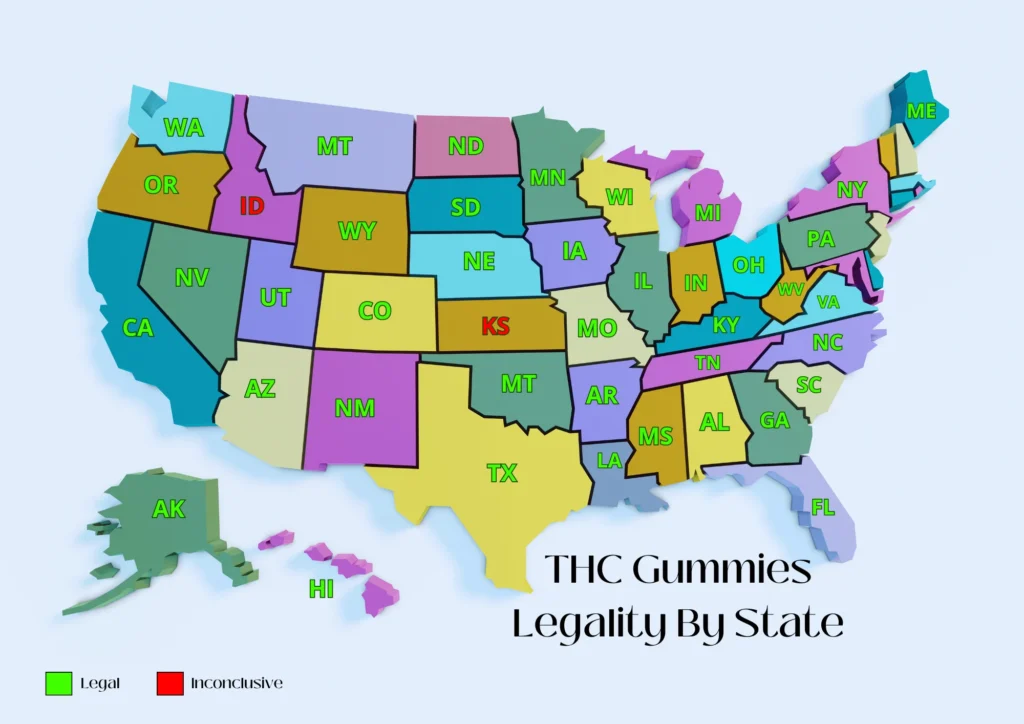
The following sections will look into the legalities per state. If you live within these US regions, take note of the following information.
Alabama
Quick Answer: Yes
Alabama adheres to the Farm Bill and its restrictions. In 2019, the state enacted Alabama Senate Bill 225, which lifted the restriction on the sale, production, and purchase of hemp-derived products that comply with the THC limit.
In effect, Delta-9 THC gummies are legal as long as they comply with two primary conditions: the products must be hemp-derived, and the THC must not go over the 0.3 percent threshold by dry weight.
While Alabama has a medical cannabis program in place, recreational use remains illegal statewide.
Alaska
Quick Answer: Yes
Unlike Alabama, cannabis laws in “The Land of the Midnight Sun” are less restrictive. In 2014, the state permitted recreational cannabis use for people above 21 years old. This rule applies to tourists and residents.
Given these stipulations, anyone can purchase THC gummies in licensed establishments as long as they can show valid proof of identification.
Regarding the allow, a new ruling enacted in September 2021 permitted retailers to sell edible products with a THC content of 10 milligrams. This is a doubled amount from the 5-milligram limit imposed in 2016.
Arizona
Quick Answer: Yes
Arizona permits the use of both legal and recreational cannabis as of 2020, leading to a relatively booming business that includes around 100 dispensaries across the state. The same rules apply, limiting purchases to people 21 years and older.
Consumers are likewise allowed to buy products that contain up to five grams of concentrates, the active ingredient in edibles. However, products like gummies are limited to ten-milligram pieces to complete the allowable total amount of 100 milligrams per container.
Arkansas
Quick Answer: Yes
The state of Arkansas has regulated edible cannabis for medical use. That means medical cannabis cardholders are allowed to purchase products such as gummies in licensed establishments. In terms of the amount, patients can buy up to 2.5 ounces of edibles every 14 days.
However, it’s important to note that these stipulations must adhere to the 2018 Farm Bill and the allowable Delta-9 THC limit. Arkansas also tried to impose a ban on Delta-8 THC, but a federal judge blocked it in 2023.
California
Quick Answer: Yes
California is one of the most lax states when it comes to cannabis regulations. Recreational use has been legal since 2018, allowing anyone above 21 years old to purchase products from a licensed dispensary.
Consumers can purchase up to eight grams of concentrate-infused products. That includes edibles like THC gummies.
However, a recent report revealed that the California government is planning to impose stricter regulations to protect children from possible accidental consumption. While the rules are still subject to approval, the enactment would mean products should have no “detectable” amount of THC.
Colorado
Quick Answer: Yes
Like California, Colorado is a pro-cannabis state. Recreational use has been legal since 2014, making it the first state to allow recreational use for adults 21 and over.
That said, the local government makes it a point to remind consumers about the safety of edible consumption. If you’re of legal age to purchase weed in Colorado, you’re allowed up to 800 mg of edibles, whether it’s in chocolate or gummy form.
18-year-olds can also buy THC from a licensed dispensary. However, they must show a medical card to buy up to eight grams of edibles.
Connecticut
Quick Answer: Yes
THC gummies are legal in Connecticut. However, the state is particular about specific regulations about packaging and marketing edible products.
For one, they should not appeal to people younger than 21. That means manufacturers should limit the shape of their gummies to cuboid or spherical shapes. Animal shapes like gummy bears are prohibited, as they can appeal to children.
Each package must also clearly indicate the presence of THC through stamps and marks. It must also include serving sizes; each gummy must not exceed five milligrams, and an entire package must not exceed 100 milligrams.
Delaware
Quick Answer: Yes
Delaware is one of the latest additions to the list of states that legalized recreational cannabis. Since April 2023, residents and tourists aged 21 and above can purchase and possess marijuana products.
Regarding possession, consumers can have up to 750 grams of edibles and an ounce of flowers. However, you can’t have a combination of two products simultaneously.
It’s important to note that medical cannabis has been legal in Delaware since 2015. That same year, the government enacted a law that decriminalized the possession of an ounce or less.
Florida
Quick Answer: Yes
Despite its reputation for notoriety, Florida is one of the few remaining states that has yet to legalize recreational cannabis use. And while medical marijuana use has been allowed since 2016, the local government only included edibles in the program in 2020.
As of 2022, Florida’s Department of Health enacted an emergency order restricting allowable daily purchase doses of edibles to 60 milligrams of THC. Product manufacturers must also be particular with packaging, as each serving size must not exceed ten milligrams.
Likewise, each container with multiple servings of THC gummies must not go over the 200-milligram limit. Packages must also indicate recommended serving sizes.
Georgia
Quick Answer: Yes
Georgia is one of the last remaining states in the US that implements strict cannabis laws. While major cities like Atlanta have decriminalized marijuana use, state laws only allow medical use via CBD oil. These products must contain less than 5 percent THC.
However, you can purchase Delta-9 THC gummies as long as they are hemp-derived and do not exceed the THC threshold. As it is with most states where cannabis use is legal, consumers must be 21 years old and over to purchase.
Georgia has dispensaries all over, but none are recreational in nature. That means those who intend to buy must have a medical card.
Hawaii
Quick Answer: Yes
Similar to Georgia, Hawaii prohibits recreational cannabis use and allows consumption for medical purposes. However, the state decriminalizes possession of up to three grams.
And like in Georgia, “The Aloha State” allows the use of hemp-derived Delta-9 THC products, which includes edibles like gummies. The main difference is that Hawaii imposes a 0.3% THC limit on products to coincide with the 2018 Farm Bill.
Hawaii also legalizes Delta-8 THC, permitting consumers 21 years old and over to purchase from licensed hemp retailers and online vendors. Sellers also ship products discreetly.
Idaho
Quick Answer: Inconclusive
In Idaho, it is illegal to sell, purchase, and possess any form of THC products. However, hemp-derived THC sellers say the state adheres to the 2018 Farm Bill and its restrictions. Hence, hemp-based products are legal. This is confusing for most cautious consumers.
Illinois
Quick Answer: Yes
Since the beginning of 2020, the state of Illinois has allowed residents to purchase up to 500 milligrams of THC edibles. Each product must contain a maximum of 100 grams.
Tourists, however, are only allowed to purchase half the amount. Non-American citizens are not entirely banned from using cannabis, and sanctions are as hefty as deportation.
Illinois has licensed dispensaries across the state. Consumers must be 21 years old or older and follow the guidelines and limitations to purchase. They can use these products in authorized lounges and dispensaries. Public places like school grounds and government buildings are off-limits.
Indiana
Quick Answer: Yes
Indiana continues to impose a strict stance against cannabis use, and possession may lead to fines and imprisonment. CBD is allowed as long as products don’t exceed the 0.3% THC limit.
However, Delta-8 THC is legal in the state. According to reports, this loophole exists because lawmakers didn’t know much about the psychotropic cannabinoid when both the Farm Bill and Indiana’s cannabis laws came into play.
Consumers of legal age (at least 21 years old) can purchase Delta-8 THC gummies from CBD shops. This ruling has been in effect since October 2021. As of this writing, the local government has not imposed limitations on Delta-8 products.
Iowa
Quick Answer: Yes
While recreational weed is illegal in Iowa, consumers can purchase hemp-derived products if they carry a medical cannabis card. Merchandise on sale must also adhere to the 0.3 percent THC limit.
However, new regulations took effect in July through the enactment of House File 2605. These rulings impose restrictions on the potency of products, including edibles like THC gummies.
In summary, these consumables must have a maximum of four milligrams per serving and a ten-milligram limit per container. Packages must contain warning labels similar to those for alcohol and nicotine products.
Kansas
Quick Answer: Inconclusive
Kansas classifies cannabis as a Schedule I drug, which means recreational use and unlawful possession is a misdemeanor charge. HB 2706 was proposed to allow hemp products in the state but stalled in May 2022, confusing consumers. Currently, many edible consumers can still buy from sellers within the state and in online stores.
Kentucky
Quick Answer: Yes
If you’re a Kentucky resident, you’re allowed to purchase Delta-8 and Delta-9 THC products, including tinctures, oils, and edibles like gummies. However, they must not have more than 0.3 concentration.
Part of the mandate is proper labeling, which manufacturers must indicate in their packaging. Containers must include total THC potency.
These regulations were enacted in January 2023 through Executive Order 2022-798. Two months prior, the local government enacted Executive Order 2022-799, which regulates the sale of Delta-8 THC products. Similarly, the primary ruling is that these products must contain no more than 0.3% THC.
Louisiana
Quick Answer: Yes
When Louisiana accidentally legalized consumable hemp in 2022, lawmakers were quick to make amendments. In June, the local government finalized House Bill 592, which banned the sale of hemp-derived THC products in gas stations and newly established restaurants.
The new ruling also imposed an age limit of 21 years and older and increased product testing.
As of this writing, Louisiana’s cannabis laws allow the use and purchase of hemp-derived THC products containing up to eight milligrams per serving. Delta-8 and Delta-9 products are permitted, provided that they comply with the given restrictions.
Maine
Quick Answer: Yes
In a nutshell, state laws in Maine permit recreational and medical THC use. However, consumers must comply with the imposed stipulations.
When it comes to edibles, users are allowed to have up to five grams of cannabis concentrate, which applies to edibles like THC gummies. You must be at least 21 years old to buy in licensed dispensaries across the state.
Recreational cannabis in Maine is solely for residents. Those who live out of state must possess a medical marijuana card along with valid identification.
Maryland
Quick Answer: Yes
In July 2023, lawmakers in Maryland approved recreational cannabis use for adults 21 and over. This ruling allows users to use products legally purchased in licensed dispensaries or homegrown.
Users who prefer edibles like THC gummies are permitted to buy up to 12 grams of concentrates. However, the total amount of products in their possession must not exceed 750 milligrams of THC. Local laws refer to this as the “personal use amount.”
Consumers are likewise allowed to produce homemade edibles as long as they use legally purchased or grown products. Unlicensed businesses are not allowed to infuse cannabis or CBD into food products, as “adulterating foods” remains illegal in the state.
Massachusetts
Quick Answer: Yes
Massachusetts legalized medical cannabis in 2012, followed by recreational use in 2018. These regulations allow adult consumers 21 and over to purchase from licensed dispensaries, provided they show valid identification. Foreigners are allowed to buy, but they must show their passport.
However, lawmakers have implemented daily purchasing limits. For edible users, you can buy up to 500 milligrams per person. Users can also combine purchases of other products as long as they do not exceed the daily limit.
Michigan
Quick Answer: Yes
The state of Michigan legalized recreational cannabis in 2018, making it the first Midwest territory to do so. This ruling gave legal-age herb lovers the liberty to sell, cultivate, purchase, and consume their preferred products.
Regarding edibles, users can buy up to 40 ounces, equivalent to 1,100 grams. However, it is important to note that a 16-ounce cannabis edible, like a THC gummy, equates to an ounce of flowers.
Delta-8 edibles are also legal in Michigan, but manufacturers must adhere to a container limit of 200 mg of THC. Each package of ten pieces must not exceed the 20-milligram concentration threshold.
Minnesota
Quick Answer: Yes
Minnesota’s recreational cannabis legalization has only been in effect for a little over a year. At the time, it was the 23rd state in the US to allow the possession and cultivation of marijuana among people 21 years old and above.
As it is in most states where legal cannabis is in effect, Minnesota imposes a limit on its edible products. A pack of gummies, for example, must not exceed 50 milligrams of THC concentration. That means each serving must not go over the five-milligram limit.
Mississippi
Quick Answer: Yes
“The Magnolia State” joins the list of US territories that fall right in the middle regarding cannabis legalization. Yes, Delta-9 THC is legal. However, they must be hemp-derived and not exceed the 0.3 percent limit by dry weight.
Medical cannabis users, meanwhile, have more liberty to purchase larger amounts. Mississippi calculates possession and purchase limits using the Medical Cannabis Equivalency Units (MCEU). For edibles, the standard MCEU is up to 100 milligrams of THC.
But even with these liberties, medical marijuana cardholders must also adhere to the limitations. Patients aren’t allowed more than 24 MCEUs (84 grams) per month and 28 MCEUs (98 grams) simultaneously.
Missouri
Quick Answer: Yes
Missouri lawmakers approved recreational cannabis use in November 2022, with the first licensed sales happening three months later. Since the new ruling, adults over 21 years old have been allowed to purchase up to three ounces (85 grams) of cannabis in all forms.
However, a new ruling has led to some changes. According to reports, the enactment of Executive Order 24-10, signed in August, prohibits the consumption and distribution of foods containing Delta 8 THC, Delta 10, and similar components of cannabis.
Montana
Quick Answer: Yes
Montana is progressive about its stance on cannabis use. Recreational marijuana use is permitted in the state, allowing legal-age residents and tourists from the country and all over the world to purchase products. They must carry valid identification to show they are 21 years and older.
However, users must comply with specific guidelines when buying from a licensed dispensary. They must only pay in cash. This rule adheres to ongoing federal restrictions.
Consumers are allowed to buy and possess up to 800 milligrams of THC edibles. Each package must contain no more than 100 milligrams, with each serving having a maximum of 10 milligrams of THC concentration.
Nebraska
Quick Answer: Yes
Nebraska is the opposite of Montana when it comes to marijuana laws. “The Cornhusker State” strictly complies with federal regulations, classifying cannabis as a Schedule I substance.
The state does have a slight leeway on its allowed THC content for products. Unlike the usual 0.3 percent concentration per the Farm Bill, Nebraska regulations permit the use of products with up to one percent THC. This ruling applies to all forms of cannabis, including gummies.
However, the local government has no clear guidelines on other forms of THC, like Delta-8 and Delta-10. In such cases, lawmakers recommend consulting with a legal expert.
Nevada
Quick Answer: Yes
Recreational cannabis became legal in Nevada at the beginning of 2017. The state permits consumers 21 years and older to purchase, sell, and cultivate marijuana, provided they comply with mandated laws.
State regulations impose a purchasing limit of 2.5 ounces, equivalent to 7,087 milligrams daily. Regarding edibles, users can buy up to 70 edibles, with each package having an average THC concentration of 100 milligrams.
You must present valid identification if you’re buying from a licensed dispensary. Likewise, you’re not allowed to exceed the limit mentioned above.
New Hampshire
Quick Answer: Yes
New Hampshire is likewise strict with its cannabis laws. The state follows the 2018 Farm Bill that limits possession of hemp-derived THC products like gummies with no more than 0.3 percent concentration by dry weight. This applies only to medical cannabis patients, as recreational use remains illegal.
This ruling came after lawmakers passed House Bill 459 in 2019. Part of these regulations redefined hemp as an agricultural product, ultimately removing it from the list of scheduled substances.
If you’re planning to buy hemp-derived THC in New Hampshire, you must be at least 21 years old. Users of legal age may purchase up to two ounces (56 grams) of products within ten days.
New Jersey
Quick Answer: Yes
Recreational cannabis use has been legal in New Jersey for more than three years now. This ruling allows people 21 years old and above to purchase marijuana products from licensed dispensaries. It applies to residents and visitors, provided they can show valid proof of identification.
Users can buy up to ten 100-milligram packages of edibles in one transaction. Likewise, they can combine purchases with other products as long as they don’t exceed the one-ounce (28-gram) limit.
New Mexico
Quick Answer: Yes
Recreational weed has officially been allowed in the state of New Mexico since April 2022. This was made possible by lawmakers who passed House Bill 2 (also called the Cannabis Regulation Act) in March 2021.
Like in most states where cannabis laws are more lax, the legal purchasing and possession age is at least 21 years old. Consumers must present a valid identification when buying from licensed dispensaries.
Regarding the allowable amount of THC edibles, legal-age users can buy up to 800 milligrams at one time. However, unlike other states that permit recreational use, New Mexico has not imposed a purchasing limit.
New York
Quick Answer: Yes
When recreational marijuana use became legal in the Big Apple in March 2021, it was quite a big deal. With approximately 60 million tourists annually, New York City alone saw a significant financial benefit from these new developments.
You must be 21 years old and above with valid identification to purchase cannabis in the state of New York. If qualified, you can buy up to 24 grams of edibles in a day, whether in-store or online.
However, edible packs must not exceed more than 100 milligrams of total THC. Typical serving sizes of each gummy are five and ten milligrams.
North Carolina
Quick Answer: Yes
North Carolina imposes a ban on recreational weed. However, state laws are slightly different, allowing up to 0.9 THC concentration on hemp-derived products. This ruling applies to medical cannabis patients 21 years old and above.
Serving sizes of edibles are also restricted. Each package must not exceed 50 milligrams of THC, while individual servings have a limit of ten milligrams. Packaging must also be child-resistant and tamper-proof, with clear indicators of THC content.
Regarding possession, medical cannabis patients can purchase up to 250 milligrams. However, their stash must not exceed a 90-day supply.
North Dakota
Quick Answer: Yes
It is prohibited to use cannabis for recreational purposes in North Dakota. The state complies with the 2018 Farm Bill that allows the purchase of hemp-derived products with a maximum THC concentration of 0.3 percent by dry weight.
Cannabis use is also limited to patients under the state’s medical marijuana program. Qualified users are allowed to possess a maximum total of 2,000 milligrams of cannabis products, which includes edibles like THC gummies.
Ohio
Quick Answer: Yes
Recreational cannabis has been legal in “The Buckeye State” since November 2023. Since then, adults aged 21 and over have been permitted to possess a maximum of 2.5 ounces of flower. For edibles, consumers are allowed to have up to 15 grams.
Regarding packaging, ten packs of ten-serving edibles must not exceed 1,100 milligrams of THC. Legal-age users can purchase these products from licensed dispensaries across the state.
Oklahoma
Quick Answer: Yes
Cannabis edibles are legal in the state of Oklahoma. However, recent cannabis laws stipulate that only dispensaries with licenses from the Oklahoma Medical Marijuana Authority and the state’s Department of Health are allowed to sell them.
Users must provide proper identification before they can purchase up to 72 ounces (2,000 grams) of THC edibles like gummies.
Oregon
Quick Answer: Yes
As in Oklahoma, Oregon only allows the sale of recreational cannabis in dispensaries that have government licenses. For the “Beaver State,” the Oregon Liquor and Cannabis Commission (OLCC) gives the approval.
For users, only adults 21 and up are permitted to purchase. They can possess up to 454 grams of edibles like THC gummies while in public.
Pennsylvania
Quick Answer: Yes, for gummies that melt in the mouth.
While recreational cannabis is legal in Pennsylvania, THC gummies are not. Lawmakers and board members are mostly concerned about the likelihood of these edibles being accessible and enticing for a child.
According to recent reports, other forms of edibles that easily melt in the mouth are allowed. That means users can purchase up to 30 grams of pills, oils, tinctures, and extracts because they easily dissolve in the mouth.
Rhode Island
Quick Answer: Yes
Recreational cannabis became legal in Rhode Island in 2022, 16 years after the government approved medical marijuana use. State laws are quite relaxed, allowing the possession of up to an ounce of cannabis products. This includes edibles like gummies.
Medical cannabis is allowed to possess more than double of up to two and a half ounces of products.
South Carolina
Quick Answer: Yes
South Carolina joins the states on this list that allow the use and purchasing of THC gummies but with the same caveat: products must be hemp-derived and not exceed the 0.3 percent concentration limit by dry weight.
That means products like edibles must also follow the guidelines of the 2018 Farm Bill. Recreational and medical cannabis use has yet to be legalized in the state.
South Dakota
Quick Answer: Yes
South Dakota allows the use of THC edibles that are hemp-derived and do not exceed the concentration limit of 0.3 percent. Users must be 21 years old and over.
Any forms of cannabis-derived products remain illegal. Recently, Governor Kristi Noem signed a law that banned the production and distribution of Delta-8 and Delta-10 THC.
Tennessee
Quick Answer: Yes
Hemp-derived THC gummies are legal in Tennessee, but amendments to SB 0378 added the following rules to purchasing the said products:
- Customers are required to be at least 21 years old.
- Hemp-derived products should only be sold behind the counter.
- The product should follow child-safe packaging and storage requirements.
- Packaging must contain a QR code that shows third-party lab COA results.
Texas
Quick Answer: Yes
Hemp-derived THC gummies became legal in Texas after the passage of House Bill 1325. Additionally, the state’s Compassionate Use Program allows medical-use patients to access marijuana gummies.
Utah
Quick Answer: Yes
Hemp-derived THC gummies are legal in Utah but with specified regulations according to HB 52, such as setting a THC limit. A maximum of 10% THC of the total cannabinoid content or 5mg of THC per serving.
Vermont
Quick Answer: Yes
Hemp-derived THC gummies are legal in Vermont as long as they follow the “1.5mg THC per serving and 10mg THC per packaging” rule. The only way to increase the level of hemp-derived THC per product is if it has a 20:1 CBD to THC ratio or more.
It’s important to note that the sale of hemp-derived Delta-8 and Delta-10 edibles is unregulated in Vermont. This rule was issued after an emergency rule for hemp edibles in May 2023.
Virginia
Quick Answer: Yes
Hemp-derived THC gummies are legal and available in Virginia. The state even excluded hemp products from Virginia’s 12% Marijuana Tax. However, the state government strictly implements a 2mg of THC per package threshold for minor cannabinoids: Delta 8 and Delta 10.
Washington
Quick Answer: Yes
Hemp-derived Delta 9 THC gummies are legal in Washington following the passage of the 2018 Farm Bill. The Washington State Department of Agriculture regulates hemp under the passed SB 5276.
Meanwhile, Washington restricts the sale of Delta-8 gummies even to licensed dispensaries.
Wisconsin
Quick Answer: Yes
Wisconsin recognizes the 2018 Farm Bill, which legalizes hemp-derived THC in the country. Your ability to procure, use, and possess products like THC gummies is considered legal in the Badger State.
Wyoming
Quick Answer: Yes
THC or Delta 9 gummies are legal in Wyoming as long as they adhere to the 0.3% Delta 9 THC limit. They can be accessed through online stores and physical shops. Senate File 32 is Wyoming’s piece of legislation that explicitly bans Delta 8 and Delta 10 products (whether hemp-derived or not) but not hemp-derived Delta 9 THC.
Are THC Gummies Allowed in Planes?
The THC gummies allowed on planes are those that comply with the Farm Bill’s guidelines. While they are undetectable by airport security, possessing products that exceed the limits is illegal and may be punishable by state and/or federal laws.
-
Best Seller
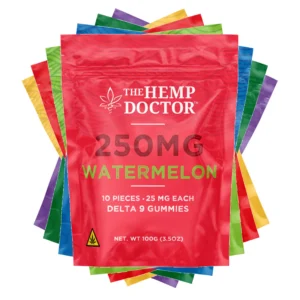
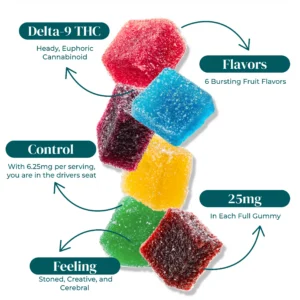
DELTA 9 THC GUMMIES | 25MG
Price range: $6.95 through $59.96 — or subscribe to save 25%Shop Now This product has multiple variants. The options may be chosen on the product page -
Back in Stock
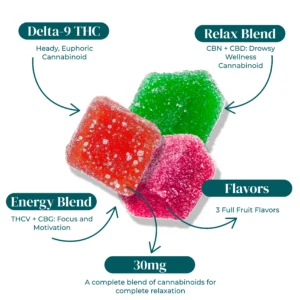
KAYO | RAPID RELEASE THC BLEND GUMMIES | 30MG
Price range: $29.95 through $54.95 — or subscribe to save 25%Shop Now This product has multiple variants. The options may be chosen on the product page
Best Legal THC Gummies
Now that you have an idea of the legal status of cannabis in all US states, you may be looking to purchase some products. The Hemp Doctor is an excellent place to start.
Feel free to check out our premium Delta 9 gummies catalog to see which products are available. You will find different varieties and flavors, each bringing a unique experience.
Get 4/20-Ready: Save Up to 80% on 4/20 Deals!
Wondering how people walk away with up to 80% off on their gummies purchase during 4/20? Here’s how to get in on the action.
- Join the Lucky Joint Club – earn points, unlock exclusive discounts, and get early access to deals.
- Bookmark the Deals Page – where limited-time steals and huge discounts live.
- Shop at the Canteen – a Lucky Joint Club members-only store of secret deals and bundles you won’t find sitewide.
- Subscribe & Save – 25% off plus free shipping on recurring orders, or add a subscription item to unlock free shipping on your bulk order.
Setting this up before 4/20 arrives means more options, better product deals, and less scrambling when things sell out.
Final Thoughts
Hopefully, this lengthy state-by-state guide has provided the necessary information. To cap things off, we’re answering some frequently asked questions.
FAQs
Are THC gummies legal in the US?
Yes, THC gummies are legal in the United States, provided that they comply with the restrictions of the 2018 Farm Bill. Products should not exceed the mandated limits.
Are THC gummies legal in the UK?
All THC edibles, including gummies, are illegal in the United Kingdom. They are classified as Class B drugs, which makes the sale, production, and supply of these products illegal.
What is the difference between THC and CBD?
The main difference is that CBD has no psychotropic effects, unlike THC. It is usually prescribed to patients for its perceived therapeutic effects.
Where is THC legal in the states?
Hemp-derived THC with THC concentrations not higher than 0.3 percent are legal throughout the United States.