
How Long Does THCP Stay in Your System? Detection Windows Explained



Quick Answer: THCP will remain detectable in your system for 2-30 days, depending on test type and how frequently you use it. However, for daily users taking a urine test, the window could extend to 45 days or longer.
You’ve used THCP recently and are about to face a drug test, so you’re wondering: how long does THCP stay in your system? And does THCP show up on a drug test at all? How long is THCP detectable in urine? What about in blood, saliva, and hair follicles?
Well, the truth is, THCP does show up on drug tests. This is because the liver breaks it down into the same THC metabolites that standard drug screening tests look for. And because of how the body absorbs and interacts with it, THCP may take a longer time to clear than delta-9 THC.
That said, THCP’s detection window will depend on factors such as your body composition, frequency of use, and method of consumption. We explain it all clearly in this guide, so keep reading.
Your personal THCP duration calculator
Select your usage frequency and consumption method to get a realistic estimate of how long THCP may remain detectable in your system.
Urine test
—
Most common test type
Blood test
—
Typically 24–48 hrs
Saliva test
—
Roadside / workplace
Hair follicle
—
Longest window
Your risk level
Select your options above to see your estimate.
These estimates are extrapolated from Delta-9 THC pharmacokinetics research. THCP-specific clearance data does not yet exist in published literature. Because THCP has higher CB1 binding affinity than Delta-9 THC, actual detection windows may be longer than these estimates suggest. This calculator is for informational purposes only and cannot predict or guarantee any drug test result. The only reliable way to clear THCP from your system is abstinence.
Does THCP Show Up on a Drug Test?
Yes. While standard drug tests don’t specifically screen for THCP, they detect THC-COOH, a metabolite produced when THCP is broken down in the liver. This is the same metabolite produced after THC use.
Once your body processes THCP, chemical evidence remains. Your liver actually produces a lot more THC metabolites when you use THCP rather than THCA. This is because THCP has a seven-carbon side chain, unlike most cannabinoids, which have a five-carbon chain.
This results in more metabolic processing, meaning there will be a lot more THC-COOH for the urine test to find. So, if you have a drug test coming up, say, in a month, pause any THCP intake completely as soon as possible.

"If you are expecting a drug test soon, better to pause the intake of THCP or any other hemp-related products completely to stay on the safe side. THC urine testing is said to test positive 95% of the time in patients with THC levels in detectable range (20-50 ng/mL)."
The Hemp Doctor Medical Reviewer
Detection Windows by Test Type
The most common tests used to screen for THC metabolites are urine tests, blood tests, saliva tests, and hair follicle tests. THCP can have different detection windows depending on the test. Let’s discuss that in detail.
Urine Tests (3 to 30 days)
So, how long does THCP stay in urine? For around 3 to 30 days, or even longer if you’re a frequent user.
Urine tests are the most common screening method used by employers and athletic and probation programs. They’re cheap, non-invasive, and can detect THC metabolites over a longer window than other standard tests.
Urine tests don’t screen for THCP, or even THC, directly. Instead, it tests for THC-COOH, one of the common THC metabolites produced in the body.
These tests detect THC-COOH at a threshold of 50ng/mL, with a confirmation test at 15 ng/mL if your sample comes back positive.
Blood Tests (24 to 48 Hours)
While THCP remains detectable in your blood for 24 to 48 hours after the last use, frequent or heavy users may have a slightly longer detection window.
That said, since blood testing is invasive, it isn’t used for routine workplace screenings. Instead, it’s mostly used in cases of roadside impairment or medical contexts.
Sweat Tests (7-14 Days)
Sweat testing is an emerging method for detecting cannabis use. Unlike urine or blood tests, sweat tests are non-invasive and can collect samples from fingerprints or sweat glands on the skin. Researchers have developed experimental test strips that detect THC metabolites in sweat through a color-changing reaction, potentially allowing for rapid roadside or workplace screening. However, these tests are still largely in the research phase and are not widely used for routine drug testing.
Saliva Tests (Up to 72 Hours)
Your saliva may test positive for up to 72 hours after the last use of a THCP product. They are typically used by law enforcement on-site because they are easy to administer. However, their short detection window makes them unsuitable for routine workplace testing.
Hair Tests (90 Days)
Hair follicle tests detect THCP for 90 days, regardless of dosage or frequency of use. This is because hair grows at a set rate, creating a timestamp of drug exposure. As hair grows, it traps THC metabolites in the shaft, creating a chronological record. Because THCP is a fat-soluble cannabinoid, its metabolites are expressed into the sebum and oils your scalp produces, eventually becoming embedded in the hair shaft itself.
That said, hair testing is relatively rare. It tends to come up in high-security employment screening or legal contexts rather than standard workplace drug testing, where urinalysis remains the default.
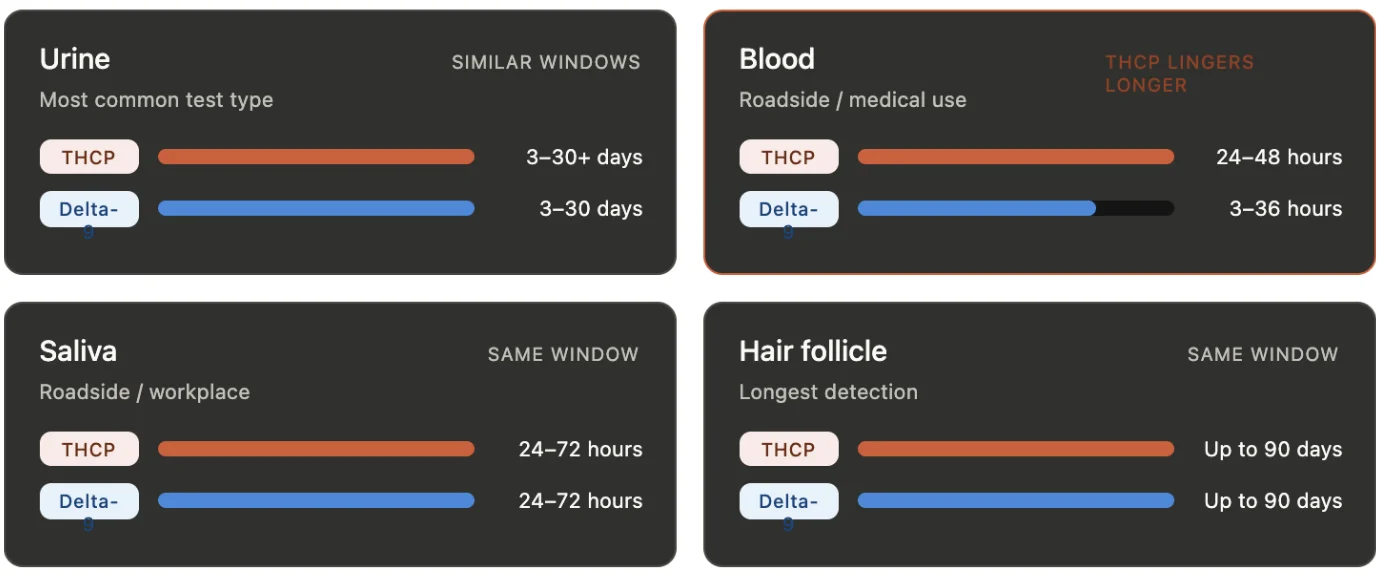
| Test Type | THCP Estimated Window | Delta-9 Estimated Window |
| Urine | 3-30+ days | 3-30 days |
| Blood | 24-48 hours | 3-4 hours (up to 36 hours for heavy use) |
| Saliva | 24-72 hours | 24-72 hours |
| Hair Follicle | Up to 90 days | Up to 90 days |
Note: Cannabis research specific to THCP is limited. These detection windows are extrapolated from Delta-9 THC data. Since they have structural and metabolic similarities, they produce metabolites that follow the same pathways in the body. However, due to its longer carbon chain, THCP has a higher affinity for CB1 receptors, leading to greater metabolite production and a longer detection window.
How Long Does THCP Stay in Your System by User Type?
When facing urine tests, different users will have different detection windows for THCP. A first-time or occasional user may return a negative test within just a few days, while a chronic user could test positive for a month or longer. Let’s break this down.
First Time or Single Use
After a single dose, the body has only a small amount of THC to process. It gets processed quickly, and THC metabolites are flushed out in urine before they accumulate in fat tissues or build up to the 50 ng/mL threshold. Within 3-5 days, your body will have cleared it all out.
Occasional User (once or twice a week)
When you eat THCP gummies once or twice a week, fresh THC metabolites are introduced into the bloodstream before the previous ones are fully flushed out. Over time, a small reservoir builds up in your fat tissue, extending your THCP detection window to 7-14 days.
Frequent User (daily or near-daily)
When THCP is part of your daily regimen, your body never fully gets rid of THC metabolites between sessions. This means they accumulate steadily in fat tissue, and the reservoir is consistently replenished. This explains why frequent users have a long detection window: 30 days, or 45-60 days for chronic users who take THCP several times a day.
| Use Pattern | Detection Window |
| First Time/ Single Use | 3-5 days |
| Occasional Use (1-2 times a week) | 7-14 days |
| Frequent Use (At least once a day) | 30 days |
| Chronic Use (Several times a day) | 45-60 days |
Factors That Affect How Long THCP Stays in Your System
Different people tend to have different detection windows. Here are some of the factors that cause this variability:
Dose & Frequency of Use
The more frequently you use THCP, the more THC metabolites accumulate in your system. The same goes for dosage. And due to THCP’s strong receptor activity, even small doses generate a lot of THC metabolites.
Individual Metabolism
A user with a high metabolism will eliminate THCP metabolites much faster than someone with a slow metabolism. Age, genetics, and physical activity all contribute to your metabolic rate.
Body Fat Percentage
THCP is a fat-soluble cannabinoid. It binds to fat cells and is gradually released into the bloodstream. If you have higher body fat levels, the body may metabolize THCP more slowly, resulting in a longer detection window.
Consumption Method
How you consume THCP helps determine its detection window. We’ll discuss this in detail in the next section.
Exercise and Dehydration
Additionally, more exercise (right before a test) and dehydration can also increase the likelihood of a positive test.
Comparing THCP Detection Times Across Consumption Methods
How you consume THCP matters. Each method results in a different THCP detection time. Here’s the complete breakdown:
THCP Vapes (3 to 30 days)
Cannabis vapes deliver cannabinoids directly into your bloodstream through the lungs, bypassing the metabolic process in the liver. The result is a clearance period of 3-30 days for occasional users.
"Using wax pens for multiple-use users has shown that it can be as long as 30 days before they test negative."
The Hemp Doctor Medical Reviewer
THCP Edibles (15 to 30+ days)
When you eat THCP edibles, the cannabinoid is broken down in the liver, resulting in the production of THC-COOH. This THC metabolite accumulates in fat tissue, resulting in a longer detection window of 15-30+ days.
THCP Tinctures (5 to 15 days)
When you use the sublingual method, some of the THCP bypasses liver metabolism. This means that while THC metabolites accumulate in your body, it happens at a slower rate than with edibles. THCP detection time when you use tinctures is 5-15 days for occasional users.
Note: The method that clears out the fastest is inhalation.
- 30%-70% off


DROP | FAST ACTING MIXER
Price range: $3.50 through $29.95 — or subscribe to save 25%Shop Now This product has multiple variants. The options may be chosen on the product page - 50% Off


PHUK’D UP | THCA LIVE SAUCE DISPOSABLE VAPE | 1G
$15.00Shop Now This product has multiple variants. The options may be chosen on the product page - 50% Off


KAYO | THC BLEND LIVE RESIN DISPOSABLE VAPE | 1G
$15.00Shop Now This product has multiple variants. The options may be chosen on the product page
How Does Your Body Process THCP?
The way your body processes THCP depends partly on how you consume it. Inhaled products, such as vapes or flower, deliver THCP directly to the bloodstream through the lungs. Oral products, such as gummies and other edibles, must first pass through the digestive system and liver before reaching the bloodstream. This process, known as first-pass metabolism, can reduce the amount of THCP that enters circulation while also producing metabolites that may extend the duration of effects.
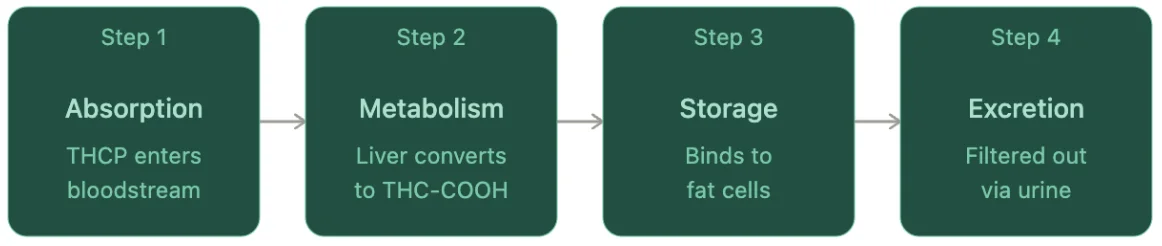
Once THCP enters the body, it follows a similar metabolic pathway to THC:
Step 1: Absorption: THCP enters the body through the lungs, digestive tract, or another delivery method and eventually reaches the bloodstream.
Step 2: Liver Metabolism: The liver breaks down THCP into various metabolites. Like THC, this process is believed to produce 11-hydroxy-THC (11-OH-THC), a psychoactive metabolite, which is then further converted into THC-COOH, an inactive metabolite commonly targeted by drug tests.
Step 3: Fat Storage: Because THCP is highly fat-soluble, its metabolites can accumulate in fatty tissues throughout the body. These stored compounds are gradually released back into the bloodstream over time, which helps explain why cannabinoid metabolites can remain detectable long after the effects have worn off.
Step 4: Gradual Excretion: As metabolites re-enter the bloodstream, they are filtered by the kidneys and eventually eliminated through urine. Smaller amounts may also be excreted through feces and sweat.
This is the same path that THC and other fat-soluble cannabinoids follow.
What Is THCP and Why Does It Stay in Your System Longer Than THC?
Tetrahydrocannabiphorol (THCP) is a chemical compound that occurs naturally in cannabis plants. Italian researchers discovered it in 2019, when they used mass spectrometry to analyze a cannabis sample.
While THCP is merely one of the hundreds or more cannabinoids present in cannabis flower, its molecular structure makes it remarkably different. Unlike every other previously identified cannabinoid, which has five carbon links, THCP has a side chain with seven carbon links.
Remember, side chain length determines how well cannabinoids bind to receptors in the endocannabinoid system. Due to its longer chain, THCP has a stronger affinity to CB1 receptors, creating a bond 33 times stronger than that of traditional THC.
This means THCP binds receptors more completely, binds more tightly, and generates a larger footprint of THC metabolites for your body to clear. That’s why this compound takes so long to clear out of your system.
THCP vs. Delta-9 THC Detection Windows By Drug-Testing Method
How to Get THCP Out of Your System?
Here’s the honest answer: no shortcut will help you flush THCP out of your body faster.
You’ll find many people selling detox drinks, herbal supplements, and other ‘cleansing’ protocols to help return a negative urine test. The truth is that these only dilute urine temporarily, causing THC-COOH concentrations to drop below 50 ng/mL, potentially helping you pass the drug screening. However, they don’t change how fast your body gets rid of THC metabolites.
More importantly, confirmation tests done using gas chromatography-mass spectrometry are much harder to pass. They have a lower cutoff of 15 ng/mL, meaning they’re likely to flag samples diluted to the point of passing the first screening.
That said, when time is on your side, here’s what may help flush THCP from your system faster:
- Abstinence
This is the only proven method to clear out THCP from your system. If you’re facing a THCP drug test, stop using THCP entirely and let your body get rid of all THC metabolites.
- Consistent Exercise
Working out regularly burns fat, releasing THC metabolites back into the bloodstream for elimination. When done over a few weeks, cardio genuinely helps flush THCP. However, avoid intense exercise 48 hours or less before the test, as it may spike THC-COOH levels.
- Hydrating (Normally)
Hydration supports kidney function and normal urine production, but excessive water intake before a drug test can dilute the sample, resulting in a “dilute” finding or requiring retesting. Extreme overhydration can also affect electrolyte balance.
- Eating a Clean Diet
Good eating habits support a healthy metabolism rate. It’s not a magic fix that gets THCP out of your system faster, but it does support the excretion of THCP metabolites over time.
THCP Half-Life and Why It Matters
The half-life of a substance is the time it takes for its concentration to decrease by 50%. Since THCP is a relatively new cannabinoid, no human clinical studies have been done to ascertain its half-life.
However, since THCP follows the same metabolic pathway as Delta-9 THC, its primary metabolite is THC-COOH, whose urinary half-life is as follows:
- Approximately 30 hours after seven days of monitoring
- 44-60 hours after twelve days
A longer THCP half-life may be observed by chronic users whose fat cells have accumulated an abundant load of THC metabolites.
In Practice: If a substance has a 30-hour half-life, after 30 hours, half of it is gone. After another 30 hours, half of what remains is gone, and so forth. It takes 5-6 rounds of halving for THC metabolites to reach negligible levels after the last use. Assuming a 44-hour half-life, it would take them 44 x 5 rounds or 44 x 6 rounds to clear out. This is equivalent to about 9-11 days.
However, it’s crucial to mention that this number is only accurate for users whose fat cells aren’t releasing more stored THC metabolites into the bloodstream, which they are if you’re a heavy user. This means THCP's half-life will be even longer for daily users.
Final Thoughts
Now that you understand THCP’s half-life and how long this fat-soluble cannabinoid can remain in your system, let’s address some other common questions about how long it stays in the body.
And remember that the only reliable way to flush THCP from your system is to stop using it completely and give your body time to excrete it naturally. Detox programs don’t help much, especially if you face confirmation testing.
Finally, always buy lab-tested THCP products, and read their Certificate of Analysis to know exactly how much THCP they have. This info will help you understand how much time you need for clearance.
FAQs
Now that you know all about the THCP half-life and how long it takes for this fat-soluble cannabinoid to leave your system, let’s answer the other commonly asked questions about THCP’s lasting period in the human body.