THCA vs. CBD: Effects, Drug Tests, and How to Choose

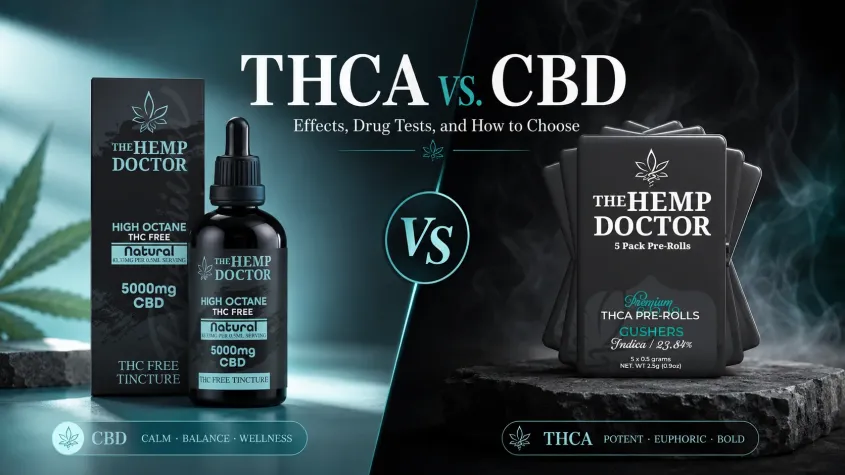
Quick Answer: THCA is the raw, non-intoxicating precursor to THC that becomes psychoactive when heated, while CBD is a separate non-psychoactive cannabinoid. Choose THCA if you want a traditional cannabis-style experience through smoking or vaping, and CBD if you want a daily, non-psychoactive hemp option.
The CBD vs. THCA question has exploded in popularity since hemp-derived products flooded the market, and the confusion is understandable. Both come from the same plant. Both may be federally legal under the 2018 Farm Bill when compliant. Both are sold in flower, gummies, and tinctures. But beyond that surface similarity, these two cannabinoids are very different in how they are used and what consumers typically expect from them.
This guide breaks down what THCA vs. CBD means at the product level, how each one may feel, where the law stands, what happens during a drug test, and which product types may make sense for your preferences.
🔑 Key Takeaways
- The THCA vs. THC vs. CBD triangle matters: THCA converts to THC when heated, while CBD remains separate and does not become intoxicating.
- Both may be federally legal as hemp-derived products containing less than 0.3% delta-9 THC, but state laws vary widely.
- THCA carries a real drug test risk once smoked or vaped. CBD is lower risk, but full-spectrum products can still trigger positives.
- THCA is mostly marketed as flower, pre-rolls, and high-potency vapes, while CBD dominates tinctures, softgels, topicals, and daily wellness formats.
What Is THCA?
THCA, or tetrahydrocannabinolic acid, is a naturally occurring cannabinoid found in raw, unheated cannabis and hemp plants. It is the acid form of THC, meaning the plant produces THCA first, and only later does it become delta-9 THC through heat or aging. In a fresh, living hemp plant, THCA is often one of the most abundant cannabinoids by weight.
On its own, THCA does not cause intoxication. That is why eating raw THCA flower will not get you high. The moment you apply heat through smoking, vaping, or baking, the compound changes into THC.
How THCA Changes With Heat
Think of THCA as THC’s “before heat” form. Raw THCA is not intoxicating. Once heated, it goes through a process called decarboxylation and becomes THC, which is associated with the familiar cannabis high.
This conversion is why THCA edibles can still get you high if they are made with heated or converted material during preparation.
What Is CBD?
CBD, short for cannabidiol, is a non-intoxicating cannabinoid found in both hemp and cannabis plants. It became widely known after the 2018 Farm Bill legalized hemp and its derivatives at the federal level. Unlike THCA, CBD does not convert into an intoxicating compound under normal consumption methods.
CBD shows up in nearly every product format you can imagine, from oil tinctures and softgels to creams, drinks, and pet products. Many adult consumers reach for it as part of a daily wellness routine, while others use it alongside THC products to create a more balanced hemp experience.
How CBD Fits Into a Hemp Routine
CBD is often chosen by adults who want a non-intoxicating hemp-derived option. Think of it less as a “high” product and more as a flexible daily-use format that can fit into morning, evening, or post-workout routines.
This is one reason CBD is often paired with THC products. Some users report that CBD may help create a smoother overall experience when used alongside THC, though effects vary from person to person. CBD appears in a wide range of CBD oil tinctures and topicals marketed for everyday wellness use.
Always consult a healthcare professional before adding any new supplement to your routine.
Where Does THC Fit In?
Here is the part most comparisons miss. The THCA vs. CBD debate is not really a two-way matchup. It is a triangle. THCA sits on one corner as the acid precursor to THC. CBD sits on a completely separate corner with its own pathway in the plant. THC sits at the top of the triangle as the destination THCA reaches once heat is applied.
When you smoke THCA flower, you are not really smoking THCA in its original form. You are inhaling delta-9 THC that was just created in real time by the heat of your lighter or vaporizer. CBD never travels that road. No matter how hot you heat CBD flower, the result is still CBD, plus some minor cannabinoids and terpenes.
This matters for legality, drug testing, and consumer experience. If you understand that THCA is essentially “THC waiting to happen,” every other piece of the comparison becomes easier to understand. For a deeper dive on this conversion, our breakdown of THCA vs THC walks through it step by step.
THCA vs. CBD: Key Differences at a Glance
Before getting into the deeper sections, here is a side-by-side look at the major THCA vs. CBD differences.
| Attribute | THCA | CBD |
| Intoxicating | No when raw, yes when heated | No, in any form |
| Converts to THC | Yes, through heat | No |
| Common formats | Flower, pre-rolls, vapes, concentrates | Tinctures, softgels, topicals, gummies |
| Drug test risk | High once smoked or vaped | Low to moderate |
| Federal legality | May be legal under 2018 Farm Bill if hemp-derived and compliant | May be legal under 2018 Farm Bill if hemp-derived and compliant |
| Typical use case | Recreational, evening, traditional cannabis-style experience | Daily wellness, calm, balance |
| Tolerance buildup | May occur with THC-style use | Generally considered lower |
How THCA and CBD Differ in Effects
The effects of these two cannabinoids land on opposite ends of the spectrum.
Intoxicating Experience
THCA in its raw form produces no high. Once heated, it converts to THC and delivers the intoxicating experience associated with cannabis, including euphoria, altered perception, and body relaxation. CBD does not produce a high under normal use. Vaping it, eating it, or using it on your skin all keep it in the non-intoxicating category.
Onset and Duration
Smoked or vaped THCA can be felt within minutes and may last roughly two to four hours. THCA edibles may take 30 minutes to two hours to kick in and can last six hours or longer.
CBD timing depends on the format. Sublingual tinctures are often felt sooner than edibles, while topicals are used for targeted application on the skin. CBD’s effects are generally subtler than THC-style effects.
Overall Consumer Experience
THCA, once converted to THC, tends to create stronger and more noticeable effects. CBD takes a gentler, non-intoxicating route and is often used by adults who want a more subtle hemp experience. The contrast is roughly like the difference between flipping a light switch and adjusting a dimmer.
Possible Wellness Benefits of THCA
The reported wellness benefits of THCA center mostly on what it becomes after heating. Adult consumers seek out THCA flower and vapes for the same reasons they reach for traditional cannabis-style products: relaxation, mood lift, appetite changes, and support for a restful night. Raw THCA, taken in tinctures or juiced flower, is used by some consumers for its non-intoxicating profile, though more research is still developing.
These statements are based on user reports and general consumer interest, not guaranteed outcomes. Effects vary by person.
Possible Wellness Benefits of CBD
CBD is commonly chosen for daily, low-key wellness support. Some users reach for it during busy weeks, as part of a wind-down routine, after physical activity, or simply as a non-intoxicating option. The wide format range means you can match it to your lifestyle, whether that looks like a morning softgel, an evening tincture, or a topical roll-on after a workout.
CBD products are not intended to diagnose, treat, cure, or prevent any disease. Always consult a healthcare professional before adding any new supplement to your routine.
THCA vs. CBD: Legal Status
Federal Law
Both THCA and CBD may be federally legal when derived from hemp containing less than 0.3% delta-9 THC by dry weight and when otherwise compliant with applicable rules. This is the threshold set by the 2018 Farm Bill, which created the modern hemp industry as we know it.
State-by-State Considerations
The federal framework is only half the story. Several states have moved to restrict or ban hemp-derived THCA specifically, often because it converts to THC when smoked. CBD enjoys broader acceptance, though some states regulate it more tightly than the federal government does. Always check the current state law before ordering. We have written about specific states like Hawaii and South Carolina for a more granular context.
We never make absolute legal assurances. Hemp law shifts year over year, and what is legal today in your state may change.
Drug Testing: Will THCA or CBD Make You Fail?
Standard workplace drug tests do not usually look for THCA or CBD directly. They typically look for THC-COOH, the marker produced after the body processes delta-9 THC. That single fact reshapes the whole drug test conversation.
Why THCA Is Riskier Than You Think
THCA flower and pre-rolls are sold as hemp-derived and legal in many places, which leads many adult consumers to assume they are drug-test safe. They are not. The moment you light a THCA preroll or hit a THCA vape, the THCA converts into delta-9 THC. Your body then processes that THC similarly to traditional cannabis, producing the same THC-COOH that drug tests are designed to catch.
There is also a less obvious risk. Even raw, unheated THCA can convert to THC during certain lab testing processes, particularly gas chromatography, which uses heat as part of the analysis. The detection window depends on test type and frequency of use.
| Test Type | General Detection Window for THC Markers |
| Urine | 3 to 30 days, sometimes longer with frequent use |
| Blood | 1 to 7 days |
| Saliva | 1 to 3 days |
| Hair | Up to 90 days |
If you are subject to drug testing, our deep dive on how long THCA stays in your system is worth reading before you buy.
Why CBD Is Not Risk-Free Either
Pure CBD isolate carries minimal drug test risk because it contains no THC. Full-spectrum CBD products, however, may legally contain up to 0.3% delta-9 THC. For most people, that trace amount is unlikely to matter, but frequent use can increase the chance of a positive result.
Common Misconceptions About THCA and CBD
Myth: THCA is just inactive CBD. Fact: They are different compounds with different structures and different plant pathways. THCA is the acid form of THC. CBD is separate.
Myth: CBD will get you high if you vape it. Fact: No standard consumption method converts CBD into an intoxicating compound. Vaping CBD delivers it faster, but does not change what it is.
Myth: THCA is the same as Delta-8 or Delta-10. Fact: Different molecules entirely. THCA is the acid precursor to delta-9 THC specifically. Delta-8 and Delta-10 are THC-related compounds with their own profiles.
Myth: If it is hemp-derived, it is drug-test safe. Fact: Hemp-derived THCA flower can cause a failed drug test once you smoke or vape it. The 0.3% delta-9 THC limit applies to the raw product, not what it becomes after heating.
Myth: CBD blocks the effects of THC. Fact: Some users report that CBD may smooth out the overall experience, but it does not erase THC’s effects. If you consume a strong THC edible, adding CBD will not instantly return you to baseline.
THCA vs. CBD Product Formats
The CBD flower vs. THCA flower question is just one slice of a larger format conversation. Each cannabinoid has natural strongholds in the market.
THCA shines in smokable and high-potency formats. Flower is the dominant category, with sativa and indica options covering different experience profiles. THCA pre-rolls make the format convenient for consumers who do not want to grind and roll. Disposable vapes, THCA concentrates like sugar-diamond sauce and bubble hash, and infused THCA gummies round out the lineup.
CBD shines in daily wellness formats. Tinctures and oils lead the category because they offer flexible serving sizes and easy sublingual use. Softgels and capsules suit consumers who want a precise, repeatable amount. Topicals like creams, salves, and roll-ons are used for localized application. Gummies and edibles give beginners an approachable entry point. Pet CBD covers a category that THCA cannot really serve at all.
Which Is Better, THCA or CBD?
The honest answer is that it depends on what you actually want. Instead of vague guidance, here are concrete scenarios.
“I want to support a restful night.” A CBD or CBN-forward tincture or softgel may be a lower-intensity starting point. If you have used cannabis-style products before and want a stronger evening experience, a heated THCA product or a full-spectrum nighttime gummy may be worth comparing.
“I want to unwind after work without getting high.” CBD is the better fit. A tincture, softgel, or topical can fit into an evening routine without intoxication.
“I have a job with random drug testing.” Avoid THCA entirely. Stick with broad-spectrum CBD or CBD isolate products, and even then, recognize that nothing is guaranteed.
“I want to try smoking flower for the first time.”THCA flower gives you a traditional cannabis-style experience, where permitted by law. Start small and go slowly.
“I want non-intoxicating daily use.” CBD across whichever format fits your routine.
“I am an experienced consumer looking for stronger effects.” THCA, especially in concentrates or infused pre-rolls, delivers one of the higher-potency options in the hemp market.
Not sure whether THCA or CBD fits your goals best? Explore The Hemp Doctor’s THCA collection to compare formats, strengths, and options before you choose.