How to Store Gummies: Keep Them Fresh, Safe, and Potent


Quick Answer: Store gummies in an airtight container in a cool, dry, dark place away from heat, sunlight, humidity, children, and pets. Room temperature works for many store-bought gummies if the label allows it, but homemade, opened, heat-sensitive, CBD, or THC gummies may do better in the fridge. For longer-term storage, freeze gummies in airtight, freezer-safe packaging and thaw them while still sealed.
Storing THC and CBD gummies in an airtight container away from heat, light, and moisture can help keep their potency intact. But if you want long-term storage, refrigeration or freezing is the way to go.
If you have ever forgotten your CBD or THC gummies in a drawer or your car’s glove box, you know the joy that comes with finally finding them. But, depending on the time they were lost, you probably also understand the disappointment of popping one into your mouth and nothing happens.
Poorly stored gummies often degrade, losing potency, flavor, and texture. In some cases, they may not even be safe to eat.
In this guide, we outline how different conditions affect gummy shelf life, what damages gummies, and how to store gummies properly based on the type of product you have.
🔑 Key Takeaways
- Gummies should always be stored in an air-tight container placed in a cool, dry place.
- THC in gummies can degrade into CBN, reducing their former strength, quality, and effectiveness.
- Heat, light, oxygen, and humidity are the main enemies of gummy freshness and potency retention.
- Freezing gummies can extend their shelf life between 12 and 18+ months.
- Homemade or artisan gummies have a much shorter shelf life than commercial gummies, as they usually don’t have preservatives.
The Four Enemies of Gummy Freshness
Some of the most common questions we get at The Hemp Doctor are “how long do gummies last,” and “can gummies go bad?”
Yes, even with proper storage, gummies have a predetermined shelf life. This is the period that the manufacturer has determined that the product will be stable and in relatively good condition. However, the shelf life isn’t fixed and changes significantly depending on environmental factors.
To know how to keep gummies fresh, you must understand the main factors that ruin them over time.
Generally, gummies have a shelf life of 6 to 12+ months. This window, however, shrinks significantly when heat, light, oxygen, and humidity enter into the equation.
Heat exposure
Exposing cannabinoid infused gummies to temperatures above 77°F is the fastest way to ruin them. Two things happen when you leave your CBD or THC gummies exposed to heat:
The first is that they soften, stick together, lose their shape, or melt. Most THC and CBD gummies are made of gelatin, which starts to melt at temperatures above 70°F. Now, sticky gummies may be inconvenient and harder to dose, but they are still effective. However, heat can take even that away.
Heat exposure degrades THC, CBD, and other cannabinoids. While THC and CBD are relatively stable at room temperature, exposure to heat degrades them, reducing the gummies’ potency. CBD degrades into cannabielsoin (CBE), hydroxyquinone, and other compounds, while THC breaks down into cannabinol (CBN).
CBN is a mildly psychoactive cannabinoid, so you can understand the disappointment you get if you thought you were taking a high THC gummy.
Exposing gummies to heat often turns them into an ineffective sticky gooey mess. A few hours are enough to cause irreversible damage.
But do gummies need to be refrigerated to preserve them? No, fortunately, this can be solved by simply storing gummies in a cool, dark place.
Light exposure
Exposure to light breaks down cannabinoids through a process called photodegradation, diminishing the gummy’s strength and quality. This is often caused by UV rays, but even exposure to artificial light can trigger and accelerate cannabinoid degradation.
It doesn’t matter whether the gummies are exposed to direct sunlight. Even indirect sunlight will chip away at the gummies’ potency if they are stored in clear packaging.
A 2026 study published in the Brazilian Journal of Analytical Chemistry found that light exposure was the most significant storage variable. The highest THC and CBD degradation rates in the study were observed in samples exposed to light.
Storing your gummies in a dark cabinet or drawer may extend their shelf life by blocking light. That’s why our delta 9 THC gummies come in opaque or dark packaging.
Oxygen exposure
Every time you open the gummies container and fail to reseal it properly, you are exposing them to air, which contains oxygen. Oxygen reacts with cannabinoids through a process called oxidation, reducing their strength and consequently, their effectiveness.
A 2024 study published in the Photochemical & Photobiological Sciences journal found that oxygen exposure dramatically increases photodegradation rates of cannabinoids, critically reducing shelf life.
The best solution is to transfer gummies into a properly sealed airtight container once you open the original packaging, and minimize how often you open it.
Humidity and moisture
Moisture is a two-headed problem. Too much humidity encourages mold growth, making your gummies unsafe to eat, but if they dry out too much, they lose their moisture content, become brittle, and their texture changes, or they develop sugar bloom.
Sugar bloom is the dusty, white coating that appears on the surface of gummies. It occurs when moisture dissolves the sugar coating on the gummies, then evaporates, leaving white sugar crystals behind. Sugar bloom is safe to eat, but it’s a sign that your storage conditions are not optimal.
Stickiness is often a sign of high humidity. Some manufacturers coat the gummies with cornstarch to make them less sticky.
Humidity control is essential, especially when refrigerating gummies. The differences in temperature can cause condensation, which may affect the texture of the gummies.
- Best Seller


REVIVE | CBD GUMMIES | 30MG
$44.95 — or subscribe to save 25%Shop Now This product has multiple variants. The options may be chosen on the product page
How to Store Gummies the Right Way
You just ordered delicious and potent THC and CBD gummies from the Hemp Doctor, and you want to keep them as fresh as possible. Here’s how to store cannabis gummies for longer:
Leave Them in the Original Package
Do not open the original package until you’re ready to consume them. The packaging for gummies is designed to protect them from light, air, and moisture, ensuring proper storage conditions.
Transfer Gummies Into an Airtight Container
Once opened, we recommend transferring the gummies to a glass jar with an airtight seal. Metal containers can work, but there’s a risk of imparting a metallic taste. If you choose a plastic container, ensure it’s food-grade BPA-free plastic.
Choose a Cool, Dark, Dry Place
Find a spot that is consistently cool, dark, and dry. Think cabinets, drawers, or lockers away from sunlight. Avoid storing gummies in the kitchen or bathroom as temperatures and humidity there fluctuate.
Humidity and Temperature Controls
To maintain cannabinoid stability and the gummy flavors, aim for a storage temperature of 60-70°F. If temperatures are higher, it’s best to store them in the fridge. If you live in a high-humidity area, you can use silica gel packets to keep humidity below 60%.
Label Your Containers and Keep Them Away From Children
Write the date you opened the package on the container to track shelf life. If the gummies have been sitting for longer than intended, discard them. Ensure the container location is not accessible to children.
Here is a table comparing the different storage methods of gummies.
| Storage method | Effectiveness | Shelf life (unopened) | Shelf life (opened) | Best for | Key requirements | Trade-off | Verdict |
| Airtight container | High | Depends on storage location | 1 to 3 months | All gummy types after opening | Glass or metal with secure lid | Needs a quality container | First line of defense after opening |
| Cool, dark place | Moderate | 3 to 6 months | 2 to 4 weeks | Sealed commercially packaged gummies | Cabinet away from heat, light, appliances | Shorter window, unreliable in summer | Best no-fridge option in cool climates |
| Refrigerator | Very High | Up to 12 months | 1 to 3 months | All gummy types, especially after opening | Interior shelf, airtight container, condensation awareness | Condensation risk if opened too quickly | Best all-around method for any opened gummy |
| Freezer | Highest | 12 months or more | Not applicable | Bulk storage, homemade gummies, long-term supply | Airtight sealed container, slow thaw at room temp | Texture change after thawing, no repeated freeze-thaw | Best for long-term when texture trade-off is acceptable |
| Humidity control | High when combined | Depends on storage location | Depends on storage location | Humid climates, summer storage, homemade gummies | Food-safe silica gel packet inside airtight container | Not a standalone method | Essential add-on in humid or hot environments |
Room Temperature vs. Refrigeration vs. Freezing: Which Is Best?
What’s the best way to store gummies? Refrigeration vs. room temperature vs freezing?
There’s no right answer to this question. The best way to store gummies depends on the type of gummies and how long you intend to store them. Here’s how the three ways compare:
Room Temperature
This works well if you intend to consume the gummies within a month or two and store them in an airtight container. If the gummies are in the unopened package, they can last for up to 12 months. Once opened, they are best consumed within a few weeks. Room-temperature storage is a convenient and inexpensive option for storing gummies.
Refrigeration
Planning to store opened packs for extended periods? Then refrigeration is the best way to go! Refrigeration prevents heat-induced degradation and slows oxidation. The trade-off is that the gummies can harden over time, or condensation may form due to temperature differences.
Freezing
Are you wondering how to store edibles long-term? Freezing is the best option for long-term storage of gummies. Cannabinoids are well preserved at freezing temperatures.
One 2019 study published in the Forensic Science International journal found that samples stored at −20°C retained virtually all the original THC after four years; in contrast, samples stored at room temperature lost 100% of THC in the same timeframe.
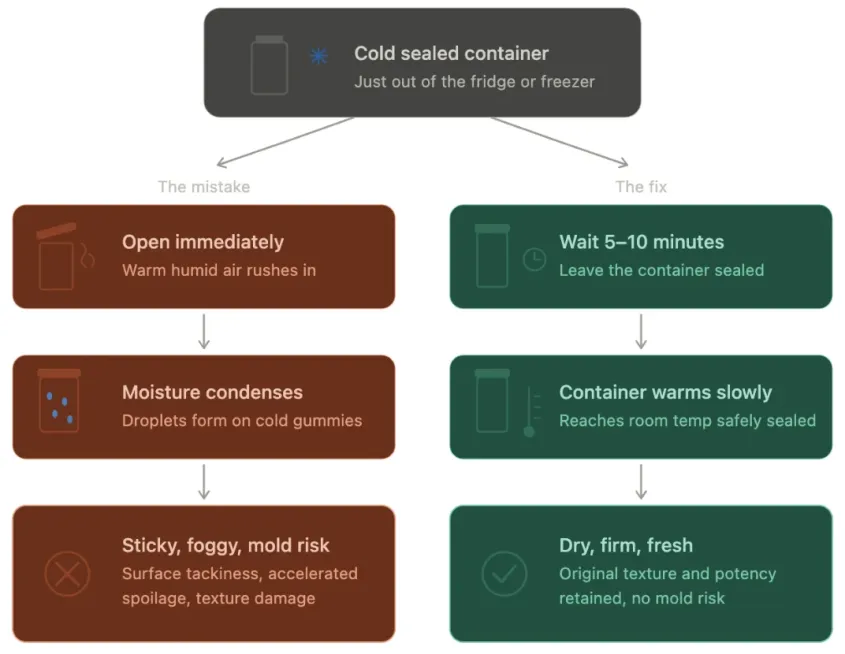
When you’re ready to consume the gummies, don’t open the cold container straight from the freezer, as doing so exposes them to warm, humid air that deposits moisture on the surface. This causes stickiness and texture changes and can accelerate mold growth.
To solve this, let the sealed container sit at room temperature for about five to ten minutes or until the gummies reach ambient temperature before opening.
This diagram shows the condensation trap. This is what happens when gummies come straight from the cold and the fix per scenario.
Gummy Storage by Type and Format
Not all gummies are created equal. This means storage needs differ by product type. Here’s how to store gummies by product type:
How to Store THC Gummies?
Learning how to store gummies with THC properly may be the difference between getting a lively high and a sedative, largely non-psychoactive experience. THC is the most sensitive cannabinoid to heat, light, and oxidation. It quickly converts to CBN when exposed to any of them.
To maintain the strength of your THC gummies, keep them sealed in an airtight container at a cool, dry place. If you don’t intend to consume them within three months and they are in an unopened package, it’s best to freeze them.
How to Store CBD Gummies?
CBD is considered to be more stable than THC, but it still degrades when exposed to heat, light, and oxygen. To maintain the dosage and consistent effects, here’s how to store CBD gummies:
- For CBD gummies you plan to use daily over time, store them in an airtight container in a dark cabinet or drawer at or below room temperature.
- If you plan to use them for more than a month, refrigerate them.
How to Store Regular Gummies?
Standard gummies can be more forgiving as they don’t contain cannabinoids that can degrade, but they still benefit from proper storage. The primary concerns with regular gummy storage are drying out, stickiness, and mold.
Regular gummies are also best stored in sealed containers at room temperature away from heat and direct sunlight. If they are to be consumed over long periods, you can store them in the fridge.
Commercially Packaged vs. Homemade Gummies
Commercially packaged gummies are easier to store than homemade gummies. This is because they often contain preservatives.
Unopened commercial gummies can stay fresh for upwards of 6 months when stored in a cool, dry place.
Homemade and artisanal gummies often don’t contain preservatives, so they can last only a few days to a few weeks at room temperature before they go bad or mold appears.
Homemade and artisanal gummies should be refrigerated after a day or two and consumed within 2 to 3 weeks. Freezing is the best option if you intend to store them longer.
Real-World Storage Scenarios: Do This, Not That
“Store gummies in an airtight container and place them in a cool, dry place away from heat sources and direct sunlight” is basically the only advice you need. However, it has been repeated so many times and is easy to overlook. It also doesn’t cover what to do in real-world situations.
Here’s what actually happens in the real world and what you should do:
| Scenario | What happens | What to do |
| Gummies left in a hot car for several hours | Melting, sticking, THC degradation | Let cool completely, check texture and smell before eating |
| Gummies stored in a gym bag | Heat, sweat moisture, compression damage | Move to a sealed container in a cool location |
| Gummies on a sunny windowsill | UV damage, texture loss, potency drop | Move immediately to a dark cabinet |
| Opened gummies left on the counter for a week | Stickiness, drying out, possible mold in humid climates | Transfer to airtight container, refrigerate |
| Gummies stored in the freezer for six months | Good potency retention, possible texture change | Thaw inside sealed container at room temperature |
| Gummies pulled straight from fridge and opened | Condensation on surface, stickiness | Let sealed container reach room temperature first |
| Gummies stored in original unopened packaging in a pantry | Optimal freshness for three to six months | No action needed, check best-by date |
How Long Do Gummies Last?
How long gummies last depends heavily on whether the package has been opened and where they are stored. Here’s a reference guide on the shelf life of gummies under different conditions:
| Storage Method | Estimated Shelf Life |
| Unopened in a cool pantry | 3-6 months (check best by date) |
| Unopened in the fridge | Up to 12 months |
| Opened in a cool pantry | 1-2 months |
| Opened in the fridge | 3-6 months |
| Frozen (sealed) | 12-18+ months |
Signs Your Gummies Have Gone Bad
Knowing when to discard your gummies is just as important as knowing how to store them. Here are some signs to watch out for:
- Visible mold growth: Fuzzy white, green, or dark spots are a definite sign that your gummies have gone bad and should be discarded immediately.
- Discoloration: Unusual changes in color, spots, or streaks indicate your gummies are spoiled.
- Change in texture: Fresh gummies are firm and chewy; if they become overly sticky, slimy, or excessively hard, they may be well past their prime.
- Unusual smell: If you smell sour, fermented, and off odors that weren’t there when you first opened the package, it may be a sign the gummies have gone bad.
- Off taste: Sometimes the gummies will not have visible signs of spoilage. But if the flavor is off or diminished, it’s a sign that they are at the end of their shelf life.
THD Gummy Storage: What the Label Is Telling You
On a cannabis gummies’ label, you will see the instructions to store the gummies in a “cool, dry place away from direct sunlight.” A cool, dry place is ideally between 60 and 70°F and with low humidity. “Away from direct sunlight“ means a closed cabinet, drawer, or opaque container. A clear jar on a countertop or windowsill won’t cut it.
Once you open the package, its built-in protection against light, humidity, and air is compromised. It’s best to transfer the remaining gummies into a well-sealed, air-tight container and store them in the conditions outlined in this article.
Are you looking for high-quality, potent gummies with a longer shelf life? Grab the strongest Delta 8 THC gummies, delta 9 THC gummies, THCA gummies, and CBD gummies at The Hemp Doctor, America’s premier hemp and CBD dispensary.