Delta 10 THC: What is it & How it Stacks With Other Cannabinoids

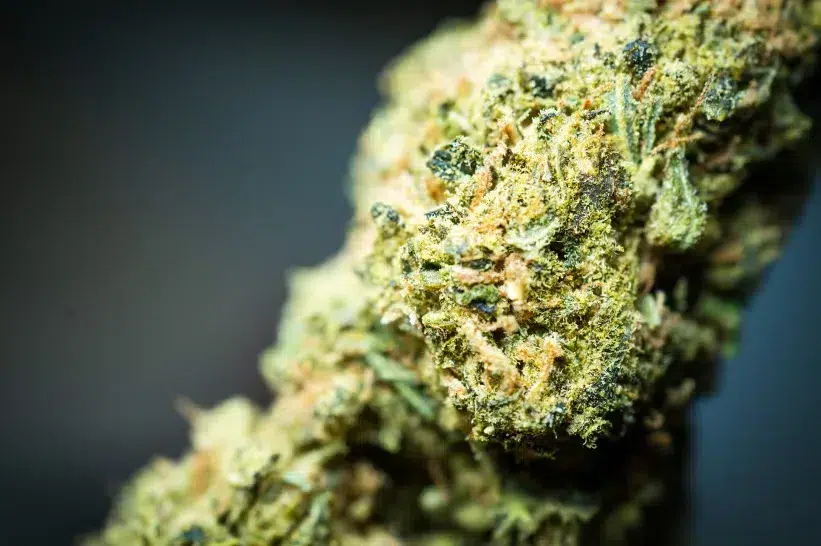
The cannabis industry is constantly introducing and reintroducing cannabinoids, shedding light on various iterations of cannabis-inspired effects and benefits. One of the latest compounds to come out is Delta 10 THC—a crystal clear compound often compared to Delta 8 effects.
Delta 10 is less potent than Delta 9, but people are still curious about it as it’s not regulated on a federal level. This blog strips down this curious compound, its uses, legal standing, and how it levels with other popular THC analogs.
🔑 Key Takeaways
- Delta 10 is a rediscovered cannabinoid that gained popularity in 2020. Its psychoactive strength is similar to Delta 8 products, but unlike Delta 8’s calming effects, Delta 10 has an energizing effect.
- Most brands opt for a scientific approach to manufacturing Delta 10. This involves converting either CBD or Delta 9 THC.
- Delta 10 is offered in various consumption methods, each with unique dosing techniques: vapes, gummies, tinctures, flowers, dabs, etc.
- The legality of Delta 10 chiefly hinges on state-based laws and protocols about the compound.
What is Delta 10 THC?
Delta 10 THC, also known as Delta 10, is an “accidental” cannabinoid discovered in 2020. A cannabis company unknowingly purchased a plot of cannabis farm contaminated by fire retardant as wildfires were then rampant in California.
After extracting the cannabis biomass and stripping it off of the fire retardant chemicals, chemists found some crystals forming in the distillate. The isolated crystals were later reported to be Δ10-THC or Delta 10.
It’s interesting to note that Delta 10 reportedly offers a less intoxicating effect than Delta 9. It can also be synthesized from legal hemp, which has enabled the creation of various product forms, such as vape distillates, gummies, and edibles.
- 60% Off

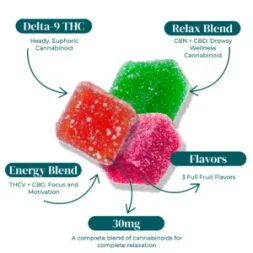
KAYO | RAPID RELEASE THC BLEND GUMMIES | 30MG
Price range: $29.95 through $54.95 — or subscribe to save 25%Shop Now This product has multiple variants. The options may be chosen on the product page - 60% Off
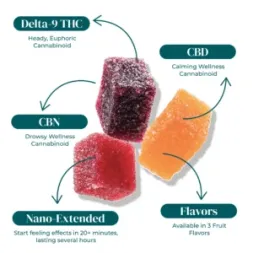
CBN:CBD:D9 THC EXTENDED-RELEASE NIGHTTIME GUMMIES | 30MG
Price range: $5.95 through $47.95 — or subscribe to save 25%Shop Now This product has multiple variants. The options may be chosen on the product page
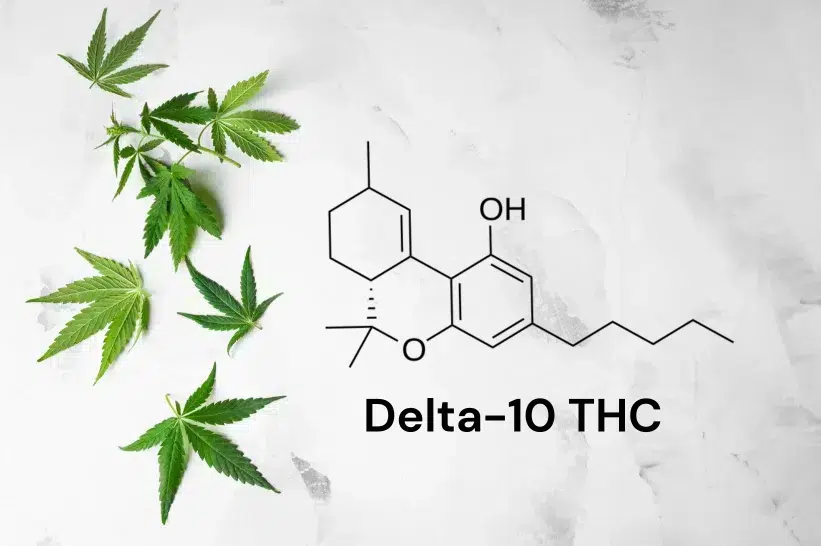
Delta 10 THC Structure
The naturally occurring cannabinoid Delta 10 is an isomer of popular compounds Delta 8 and Delta 9. All three compounds have the same chemical formula but a unique carbon atom arrangement, which gives them slightly varying effects.
Delta 10’s chemical structure contains a double carbon bond at the 10th position, hence the name “Delta 10 THC.” The same naming principle applies to Delta 9, Delta 8, etc.
How Does Delta 10 Work?
So far, only a handful of research has been done on how Delta 10 works in the body. What’s clear is since it’s part of the THC family and is psychoactive, it must have some interaction with the human endocannabinoid system (ECS).
The ECS is an intricate network of chemical signals and receptors (CB1 and CB2) scattered throughout the nervous system and other body parts. It is the main channel through which cannabinoids like CBD (cannabidiol) and THC can exert their effects.
Since the ECS’s presence is encompassing (it engages the brain, reproductive area, etc.), Delta 10’s effects are also as systemic as other THC.
Delta 10 THC Effects
The compound’s appeal to the market is mostly attributed to its less intoxicating effects and the fact that it’s less regulated compared to the classic marijuana compound Delta 9. As to other uses, Delta 10 has a huge gap between compounds like CBD and CBN, with the latter compounds having a huge research base.
Nevertheless, Delta 10’s effects are quite interesting. Its psychoactive effect is described as mild but has a polarizing effect that is said to be energizing or even mood-boosting. Alternately, for others, Deltas 10’s mellow high is supplemental for relaxing, taking a break from an arduous activity, getting in the mood, etc.
These opposing effects can result from different individual tolerance levels and the additional contents included in the product formulation. It’s no secret that the experience of taking cannabis compounds varies across users.
Delta 10 THC Side Effects
In general, cannabinoids are well-tolerated by both humans and animals. Unless contaminated with other drugs, reaching a certain toxicity level among cannabis compounds is rare. Even if you’ve exceeded what you can handle, the worst side effect to expect is reminiscent of a “bad trip.”
There is limited documentation regarding Delta 10’s safety profile as of now. The most credible sources for its safety track are anecdotal reports and similarities to the effects of Delta 8 and related compounds.
Here are some Delta 10 side effects to note:
- Temporary short-term memory loss
- Anxiety
- Dizziness
- Sleepiness
- Nausea
- Stomachache
- Diarrhea
- Headache
You can avoid these side effects by starting small and slightly increasing. It’s also important to purchase quality, non-counterfeit products to avoid unexpected side effects.
How Is Delta 10 Made?
Delta 10 THC can only be naturally found in trace amounts. There isn’t enough compound to be organically extracted for real economic use. Hence, like Delta 8, Delta 10 is prepared in labs by extracting or converting compounds such as Delta 9 or CBD.
If the source of the conversion process is Delta 9, process isomerization is applied. Converting Delta 9 to 10 is possible because of the close similarity in chemical structures. CBD-sourced Delta 10’s undergo chemical alteration using CBD isolate or CBD crude. Carbon and vitamin C derivatives trigger that chemical reaction from CBD crudes, while isolates use solvents and acids.
Can Delta 10 Get You High?
Delta 10 can get you high, but the intensity is significantly milder than regular Delta 9. Anecdotally, the high is described as energizing and likened to the Sativa-like effects of strains—Sour Diesel, Pineapple Express, and Super Lemon Haze.
If you have ingested a Delta 8 product, the strength of the high is most similar to that of Delta 10. The only distinction is that if Delta 8’s gentle high is calming, Delta 10’s is invigorating. Still, the experience from either compound will be entirely personal and unique.
How Strong Is Delta 10?
Delta 10’s strength and potency are slapped between Delta 8 and Delta 9. More subtle than Delta 9, Delta 10 gives an uplifting high rather than an out-of-this-world high. Delta 10 is closer to Delta 8 when it comes to the psychoactive strength spectrum, but the high leans more on the energizing side than the sedating high Delta 8 offers.
To put it into perspective, Delta 10’s high is suitable for daytime use. Its enhancing power on alertness, focus, and mood-boosting effects can be useful whenever you need a dash of creativity or go through a day filled with activities.
Delta 10 Dosing Guidelines According to Consumption Methods
Dosing Delta 10 differs per consumption method. In general, like any other cannabis compound, Delta 10 comes in different product forms. Learn how each is dosed and what dosage level fits beginners, moderate users, and experienced.
Vapes
Delta 10 vapes use a concentrated distillate heated to produce vapor. Vapes come in several forms, including disposables, pens, box mods, pod systems, etc., but they only have one goal: to produce inhalable Delta 10 vapor.
You don’t have control over the actual level of content of the e-juice unless you’re operating on completely modifiable models (like box mods). Most Delta 10 vapes are already pre-filled for you.
What you have control over is the amount of vapor you intake per session. This is determined by the number of puffs and the depth of each inhalation. The more puffs you take and the deeper your inhalation technique, the higher the level of Delta 10 dosage you introduce into your system.
Remember to consider the potency level of the product when vaping. Not all vapes have the same level of Delta 10 potency. With high-potency products, you won’t need to puff as many times to achieve the desired effect, but with lower potency, you’ll need to puff more to achieve the same result.
Vape dosage is measured using the unit—mg/ml. The “ x mg/ml” simply tells you the concentration of Delta 10 in relation to the total amount of e-liquid in the bullet or vape. Generally, a single draw can yield 0.5 ml to 1.5 ml of e-liquid.
Flowers
Delta 10 THC flower is raw hemp sprayed or doused with Delta-10-rich distillate. Most cannabis companies don’t disclose the milligram strength of their flower as it’s technically difficult to put raw hemp potency in numbers. Instead, they indicate the weight of the product. Is it 1 gram? 1 oz.?
Hence, the dosing strategy with Delta 10 is the same as with vapes. You control dosage by limiting the number of puffs you take per session and the depth of the draw. For example, beginners may start with one puff and slightly increase the number of puffs as they feel the effects waning.
Dabs
Designed for those who like their stuff super strong, Delta 10-based dabs allow users to inhale Delta 10 vapor in a concentrated, thick form. If vaping distillates are runny and liquid, Delta 10 dabs are wax meant to be inhaled through dab rigs and similar vaporizing devices.
1 to 3 puffs of Delta 10 dab is enough to gently stun experienced users. The effects will kick in as early as 30 minutes and last up to an hour.
Edibles or Gummies
Delta 10 gummies, also known as edibles, are chewed and ingested. They’re sweet, and brands offer them in different flavors and strengths. Delta 10 edibles have a standard dosage of 10 to 25 milligrams per piece. People take them as is (per gummy), or they can adjust the dosage by cutting the edible into even halves or quarters.
Since edibles need to undergo an elaborate digestion process before the compound can even enter the bloodstream, the onset of effects can take about 2 hours. Once the effects kick in, though, they continue for hours.
Be wary about accidentally doubling your dosage intake with Delta 10 edibles. Increasing dosage won’t speed up the onset process. Wait before the effects kick in and ascertain whether to add a gummy.
Tinctures
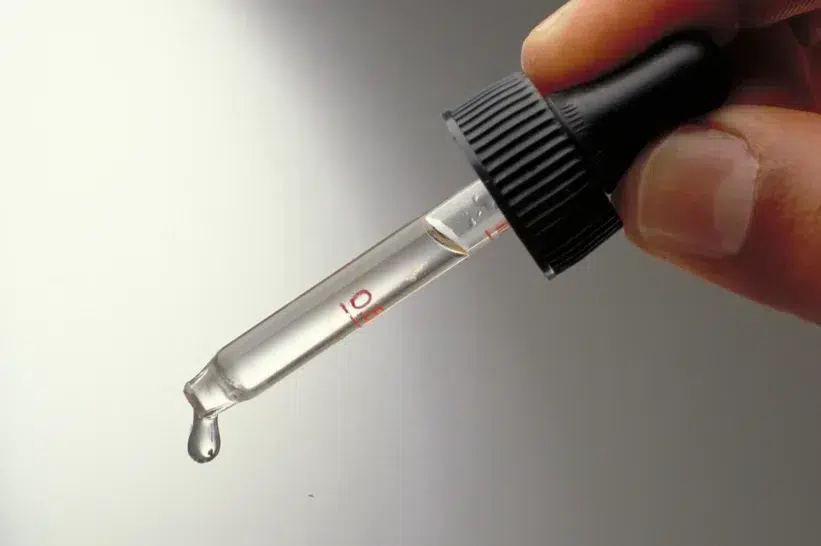
Oils or tinctures are edible Delta 10 distillates fall in drops under the tongue using a dropper that also acts as the stopper for the vial. This sublingual method of consumption needs users to hold the product under their tongue for 30 seconds before swallowing the rest of the contents. The effects should kick in within an hour.
The bottle’s dropper cap holds a full milliliter of Delta-10 dose. It’s lined with hash marks or measurement marks so users can adjust the dose according to their desired milliliters.
Delta-10 oils and tinctures are easy to dose. Most companies include dosing instructions on the back of the box or a pamphlet inside the package. Standard dosing requires first-time users to start with a half-filled dropper.
Observe the effects and assess if it needs an extra dose to achieve your desired results. If you need more, add 1/4th of the dropper at a time.
As a dosing rule followed across cannabis compounds, starting low and slowly increasing in increments is key in safely introducing new substances into your body.
This approach helps prevent overloading your body with excessive product, which can stress filtering systems like your kidneys and lead to unpleasant side effects.
Comparing Delta 10 With Other Cannabinoids
Consumers seek alternatives to the elusive Delta 9. Compounds often mentioned as substitutes include Delta 8 and, lately, Delta 10. But how do these cannabinoids differ from one another? Here’s a rundown.
Delta 8 vs. Delta 10
Among all cannabinoids, Delta 10 is the closest to Delta 8 when it comes to effects, legality, and how both cannabinoids are marketed. However, both have defining qualities that distinguish them. For example, Delta 8 is known for its sedating effects, while Delta 10 is acknowledged for its sativa-like effects.
The main cause of Delta 8 and Delta 10’s polar effects is the placement of the double bond in their atomic arrangement. Delta 8’s double bond attaches itself to the eight-carbon chain, while Delta 9’s is at the 10th carbon chain.
Delta 10 vs. Delta 9 THC
Delta 9 has a stronger binding affinity to the CB1 receptors of the ECS, which explains Delta 10’s less potent psychoactive effects than the major cannabinoid. Moreover, Delta 10’s high is more of a buzzy and energizing experience compared to the full-body high users report from taking Delta 10.
Another notable difference between Delta 10 and Delta 9 is their legal status. There is significant concern regarding the commercial distribution of Delta 9, as any product containing more than 0.3% Delta 9 is considered illegal at the federal level. On the other hand, Delta 10 is compliant as long as its product contains less than 0.3% Delta 9 and is not banned by the state.
Are you unsure whether you should choose Delta 8 or Delta 9? Join Courtney as she delves into the distinct characteristics of these two compounds alongside expert Robert Shade. In this informative discussion, you’ll gain a deeper understanding of the unique properties and potential benefits of each compound.
Is Delta 10 Legal?
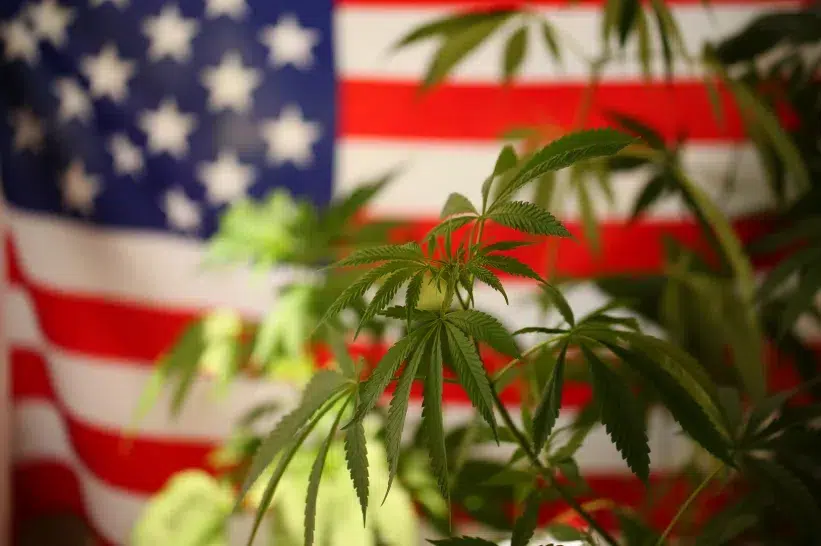
Hemp-derived Delta 10 products are federally legal in the sense that “hemp” and its derivatives have been made legal under the Agriculture Improvement Act of 2018. This reasoning keeps Delta 10 products, with less than 0.3% of Delta 9 openly sold in the country.
What’s unregulated at the moment is marijuana-derived Delta 10 due to the possible mix of traces of Delta 9 THC. However, it is unlikely to find marijuana-derived Delta 10 products because organic Delta 10 is naturally scarce in cannabis plants.
The question then arises whether using Delta 9 or CBD for Delta 10 creation equates to a marijuana product in the eyes of the law.
The answer lies in state laws, local protocols, and how active the enforcement of these laws in counties and cities. Because states are given the liberty to interpret and form their laws on cannabis medical and recreational use, individuals who are interested in purchasing Delta 10 should review the laws present in the jurisdiction first.
That said, here’s what you should know about the rules and regulations of purchasing, possessing, and selling Delta 10 products in the following states:
Is Delta 10 THC Legal in Texas?
Delta 10 is not illegal in Texas, nor is Delta 8. Here’s why.
According to the Texan Health and Safety Code Section 481.103, the state penalizes any amount of tetrahydrocannabinols, synthetic equivalents contained in the marijuana plants, and their isomers.
There is an exemption to be noted, though. Section 481.002 continues that an exemption applies to hemp and THC in hemp.
As defined in Agriculture Code Section 121.001, hemp includes all derivatives, extracts, cannabinoids, isomers, acids, and salt with a Delta 9 THC concentration below 0.3% on a dry weight basis.
As a result, Delta 10 products with less than 0.3% Delta 9 concentration are considered legal in Texas.
Is Delta 10 THC legal in Florida?
For the past years, Delta 10, with less than 0.3% Delta 9, has been freely sold in Florida. Stores need only to follow the state’s regulatory framework on testing, packaging, labeling, and marketing.
As of this year, Florida threatens to ban Delta 10, including Delta 8, through Senate Bill 1698, which, once signed into law, will become effective in October 2024.
Is Delta 10 THC Legal in Georgia?
The steady Georgia cannabis industry woke up with a newly passed Senate Bill 494 on April 30, 2024. Companies and stores were given a grace period to comply with the new laws concerning age limits, advertisement restrictions, licensing, testing requirements, and bans on certain products.
SB 494, however, didn’t change anything concerning consumable hemp products like hemp extracts, Delta 10 THC, or Delta 8. The 2019 ruling, legalizing a wide variety of hemp extracts as long as products adhere to the 0.3% Delta 9 threshold, stands.
Safe to say, hemp-derived Delta 10 products are still legal in Georgia today.
Is Delta 10 THC Legal in Indiana?
Yes, Delta 10 can be legally sold in Indiana and is available in vape shops and other stores. Indiana recognizes limitations and exemptions stipulated in the Agriculture Improvement Act of 2018.
Locals should note, however, that Delta 10 products can only be legally sold to individuals 21 or older.
Is Delta 10 THC Legal in North Carolina? (NC)
Yes. North Carolina adheres to the 2018 Farm Bill, which legalizes products like Delta 10 THC containing a maximum of 0.3% THC concentration. Additionally, residents are allowed to ship legal Delta 10 products from other states into the jurisdiction of North Carolina.
Final Thoughts
Delta 10 is a newly rediscovered THC isomer that is slowly gaining popularity as the latest “legal mild weed” to hit the market. Dubbed the new “chill pill,” attracted consumers still need to take every brand’s marketing messaging about the compound with a grain of salt. Compliance and quality are defining characteristics that potential customers have to look at first more than anything.
At The Hemp Doctor, we understand the significance of transparency and providing top-notch hemp-derived products. That’s why we proudly invite our customers to explore a wide range of cannabinoid products from our collection. Whether it’s Delta 8, -9, THCA, or CBD, we are fully prepared to exceed your expectations!
| Disclaimer: The website updates its blogs regularly with new information, particularly about the legal status of cannabis and its compounds. However, you are responsible for periodically checking the laws in your area regarding Delta 10 and related products, as they can change at any moment. |
FAQs
Will Delta 10 test positive for THC?
Yes. Unfortunately, part of the risk of taking Delta 10 is testing positive for THC metabolites—the signifying factor for marijuana and other drug tests.
How long does Delta 10 THC stay in your system?
In general, metabolites of Delta 10 can stay in your system for up to two days. For regular and heavy users, the metabolites can stay for a month.
What are the alternatives closest to Delta 10 effects?
Some of the cannabinoids closest to Delta 10 in terms of effects are Delta 8, Delta 9, and THCA
Does Delta 10 have THC?
Delta 10 is under the umbrella of the THC family and is, therefore, related to Delta 9. However, for legal Delta 10 products, the content rarely has more than 0.3% Delta 9 THC on them.
How much THC is in Delta 10?
The THC content of Delta 10 products varies among brands and product forms. What’s clear is that Delta 10 products available nationwide have less than 0.3% Delta 9 THC.
Is Delta 10 THC synthetic?
Experts debate the synthetic nature of Delta 10, which is derived from naturally occurring compounds (Delta 9 and CBD) but synthesized in laboratories.
Is Delta 10 real weed?
Delta 10 is naturally derived from cannabis plants. However, most brands choose to have it synthesized in labs to reduce the cost of using large amounts of plant materials to produce a small vial of the extract.
Is Delta 10 CBD?
No, but CBD can be converted into Delta 10.
Is Delta 10 safe?
Like most cannabinoids with few dedicated medical research explorations on them, the safety profile of Delta 10 is currently unknown.